Heel pain: plantar fasciitis or a pinched nerve?
Stretching and new shoes haven’t worked? A small nerve under the heel can cause pain that looks just like plantar fasciitis. Here are the clues.

By Efe Ozturk, DPM · 4 min read
Medically reviewed by Efe Ozturk, DPM · Last reviewed
You have done what everyone tells you to do for heel pain. You stretched, bought better shoes, tried an insert. And it is still there. If that sounds familiar, it is fair to ask whether the plantar fascia, the thick band along the bottom of your foot, is really the whole story.
Sometimes it isn’t. A small nerve that runs under the heel can be squeezed or irritated, and it can produce pain that looks a lot like plantar fasciitis.
Why plantar fasciitis comes first
Plantar fasciitis is the usual explanation for heel pain, and for good reason. The classic picture is sharp pain right at the heel.[1] Most cases come from overuse, and non-surgical care handles most of them. The same source also notes that it can be hard to treat and that pain sometimes comes back.[1] That is why a stubborn case deserves a second look rather than more of the same.
If you want a closer look at the plantar fascia side of the story, our sister practice explains it well in morning heel pain and plantar fasciitis (external site).
The nerve that can mimic it
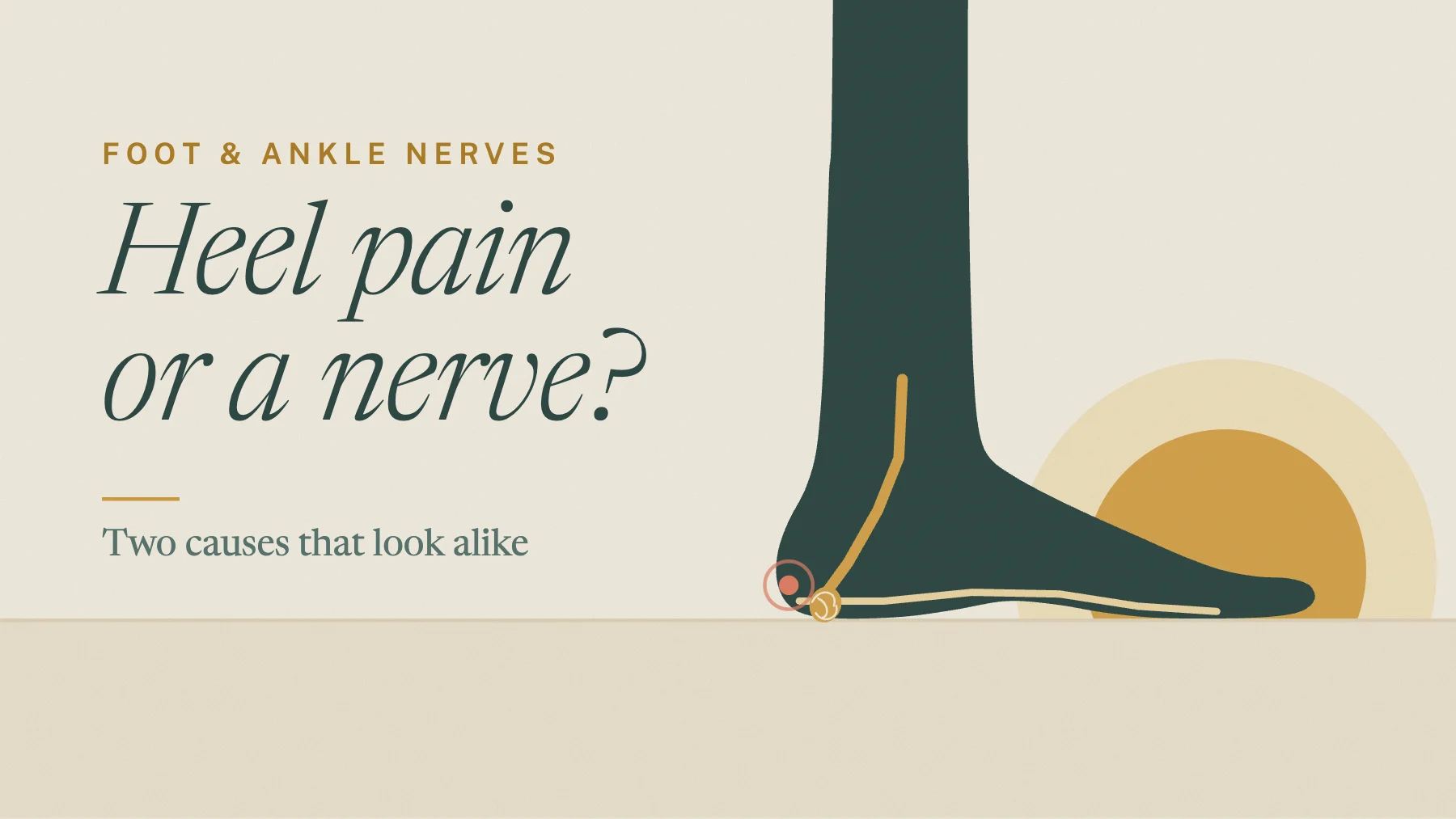
The nerve in question is sometimes called Baxter’s nerve, the first branch of the lateral plantar nerve. It branches off near the inner ankle and turns to run beneath the heel. Where it changes direction, it can be compressed.[2,4] When that happens near the heel, doctors sometimes call it distal tarsal tunnel syndrome, and it is often first mistaken for plantar fasciitis.[3]
A review of heel pain of nerve origin concluded that nerve entrapment can play a role in both the early phase of heel pain and in cases that don’t settle. It also points out that how to diagnose and manage it is still debated.[2]
Clues that a nerve may be involved
None of these proves anything on its own, and many people with plantar fasciitis have some of them. But they are worth mentioning to your clinician:
- Burning, tingling or an electric quality to the pain, rather than only a sharp or aching pain
- Pain that sits toward the inner side of the heel, or feels deeper or further forward than you expected
- Pain that builds through the day with standing and walking instead of being worst with the first steps
- Symptoms that spread into the sole or arch, or that a tap behind the inner ankle brings on
- Heel pain that has not improved with a well-tried course of the usual care
A related nerve problem is tarsal tunnel syndrome, where the main tibial nerve is squeezed at the inner ankle. It tends to cause burning, tingling or numbness in the sole, often worse with standing or walking.[5,6]
How doctors tell them apart
The diagnosis is mainly made in the office. Your clinician looks for the exact spot of tenderness, whether pressing over the nerve reproduces your pain, the strength of the small foot muscles, your foot alignment and your shoes. They also think about other causes of heel pain, including a stress fracture, a thinned heel fat pad and a pinched nerve in the lower back.
MRI can help rule out other problems, but it does not settle the question by itself. One finding, fatty change in a small muscle that this nerve supplies, has been linked to Baxter’s nerve problems. A 2025 systematic review found that same change in roughly 4% to 11% of people in the general population, at similar rates in people with and without foot pain. The authors concluded that its meaning is still unknown.[7]
In other words, the scan is one piece of the picture. The story and the examination matter more.
What helps
Treatment for a possible nerve component builds on the same foundations as other heel pain:
- Supportive, cushioned shoes, and not walking barefoot on hard floors
- Heel cups or orthotics that support the arch
- Stretching and strengthening with a physical therapist, sometimes with gentle nerve-gliding exercises
- A temporary break from high-impact activity
- In selected cases, an injection
Improvement is usually slow, measured in months rather than weeks.[2] Surgery to release the nerve is reserved for heel pain that is persistent and disabling after many months of well-tried non-surgical care. It is sometimes combined with a partial release of the plantar fascia.[4,8] Because the evidence is limited and the diagnosis can be hard, choosing the right person for surgery matters. A good evaluation is also meant to help you avoid an operation that is unlikely to help.
To learn more, see Baxter’s nerve entrapment and nerve entrapment in the foot and ankle.
When to see a specialist
Consider an evaluation if heel pain has lasted more than a few weeks despite rest, supportive shoes and stretching, if it wakes you at night or is present at rest, or if you notice numbness, tingling or burning. If you have diabetes, have any heel pain or heel wound checked promptly.

About the author
Efe Ozturk, DPM
Foot and Ankle Surgeon. Dr. Ozturk is double board certified, as a Diplomate of the American Board of Podiatric Medicine (DABPM) and a Fellow of the Academy of Physicians in Wound Healing (FAPWH), and is a Fellow of the American Society of Podiatric Surgeons (FASPS) and the American Society of Podiatric Medicine (FASPM). He leads the Lower Extremity Nerve Institute, a specialty practice of Ozturk Foot & Ankle, and sees patients in Lyndhurst, Paramus and Millburn, New Jersey.
References
- 1.Buchanan BK, Sina RE, Kushner D. Plantar Fasciitis. In: StatPearls. StatPearls Publishing; updated 2026. PubMed 28613727 (external site)
- 2.Alshami AM, Souvlis T, Coppieters MW. A review of plantar heel pain of neural origin: differential diagnosis and management. Man Ther. 2008;13(2):103-111. PubMed 17400020 (external site)
- 3.Ferkel E, Davis WH, Ellington JK. Entrapment neuropathies of the foot and ankle. Clin Sports Med. 2015;34(4):791-801. PubMed 26409596 (external site)
- 4.Pomeroy G, Wilton J, Anthony S. Entrapment neuropathy about the foot and ankle: an update. J Am Acad Orthop Surg. 2015;23(1):58-66. PubMed 25538131 (external site)
- 5.Adler L, Bergman R, Kaiser K. Posterior Tarsal Tunnel Syndrome. In: StatPearls. StatPearls Publishing; updated 2026. PubMed 30020645 (external site)
- 6.McSweeney SC, Cichero M. Tarsal tunnel syndrome — a narrative literature review. Foot (Edinb). 2015;25(4):244-250. PubMed 26546070 (external site)
- 7.Chen JSC, Abbott M, Landorf KB. Association of Baxter’s neuropathy and fatty infiltration of the abductor digiti minimi muscle on magnetic resonance imaging: a systematic review. J Foot Ankle Res. 2025;18(3):e70075. PubMed 40836398 (external site)
- 8.Bojovic M, Dimitrijevic S, Olory BCR, et al. Overview of nerve entrapment syndromes in the foot and ankle. Int Orthop. 2025;49(4):853-862. PubMed 40042611 (external site)
This article is general health information and isn’t a substitute for advice from a clinician who knows your history. Read our medical disclaimer and how we review content.
More from the blog
Foot & ankle nerves
Can a pinched nerve in the foot heal on its own?
Sometimes, when the pressure comes off. What affects recovery of a pinched foot nerve, what you can do meanwhile, and when to stop waiting.
Foot & ankle nerves
Morton’s neuroma injections: what to expect
What a steroid injection can and can’t do for Morton’s neuroma, how long relief lasts, and when surgery comes up.
Foot & ankle nerves
Burning in the ball of the foot: neuroma or metatarsalgia?
A click between the toes is a better clue than burning or a pebble feeling. How a neuroma and a plantar plate injury are told apart.