Condition
Baxter’s nerve entrapment
Irritation of a small nerve near the heel that can cause heel pain resembling plantar fasciitis.
Medically reviewed by Dr. Efe Ozturk · Last reviewed
Watch: Baxter’s nerve entrapment explained
Read the transcript
Heel pain that has not improved with the usual care? A small nerve beneath the heel may be part of the story. Baxter’s nerve is the first branch of the lateral plantar nerve. It runs beneath the heel, between layers of muscle, toward the outer side of the foot. It can be compressed near the inner side of the heel, and its symptoms can closely resemble plantar fasciitis. Pain on the inner side of the heel. Burning, aching or sharp pain that may spread across the underside. Pain that builds with standing, walking or running. It does not always follow the classic first-steps-in-the-morning pattern of plantar fasciitis. Compression between muscle layers, where the nerve turns beneath the heel. A thickened plantar fascia, or a heel spur near the nerve’s path. An arch that flattens excessively. Or repetitive loading, from running or long hours on hard floors. The diagnosis is mainly clinical. The examination looks for the exact point of tenderness, and whether pressing over the nerve reproduces your pain. Other causes of heel pain are considered too, including plantar fasciitis, a stress fracture of the heel bone, and tarsal tunnel syndrome. Most people are treated without surgery. Supportive, cushioned footwear, and orthotics or heel cups. Calf and plantar fascia stretching, and physical therapy. Temporarily less high-impact activity, and in selected cases an injection. Surgery to release the nerve may be considered for persistent, disabling pain that has not responded to many months of good non-surgical care. If heel pain lasts more than a few weeks despite rest, supportive shoes and stretching, an evaluation can help find the cause. To learn more, visit our website, or call the office to arrange a visit.
General education only; not a substitute for individual medical advice.
What is Baxter’s nerve entrapment?
Heel pain is very common, and plantar fasciitis is its most frequent cause.[4] In some people, however, part of the pain comes from a small nerve rather than from the plantar fascia itself.
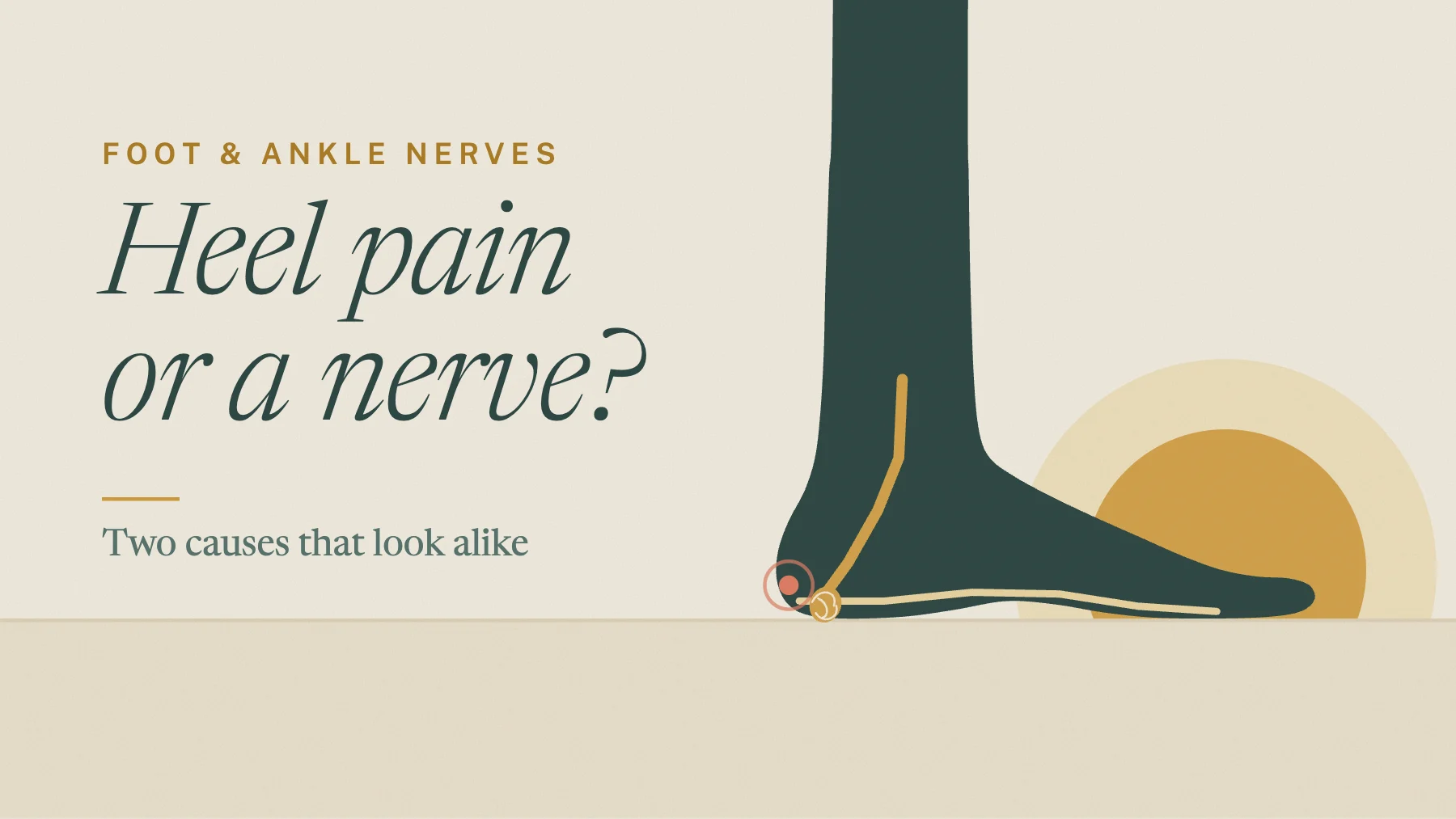
Baxter’s nerve — also called the inferior calcaneal nerve or the first branch of the lateral plantar nerve — branches off near the inner ankle and then turns to run beneath the heel, between layers of muscle, toward the outer side of the foot. Along the way it supplies a small muscle that moves the little toe (the abductor digiti minimi) and deeper tissues of the heel. Where the nerve changes direction under the heel, it can be compressed.[1,3] Some authors call this distal tarsal tunnel syndrome.[2]
Symptoms
- pain on the inner side of the heel, sometimes a little further forward or deeper than typical plantar fasciitis pain
- burning, aching or sharp pain that may spread across the underside of the heel
- pain that builds with standing, walking or running and may linger at the end of the day
- pain that doesn’t always follow the classic “first steps in the morning” pattern of plantar fasciitis
Numbness of the skin is often absent, because this branch mainly supplies muscle and deeper tissues rather than skin.[1]
What causes it?
Several factors have been linked with irritation of this nerve:[1,3]
- compression between muscle layers where the nerve turns beneath the heel
- thickening of the plantar fascia or a heel spur near the nerve’s path
- foot mechanics, such as an arch that flattens excessively
- repetitive loading from running or long hours on hard floors
- higher body weight, which increases the load on the heel
How it’s evaluated
The diagnosis is mainly clinical. The examination looks for the exact point of tenderness, whether pressing over the nerve reproduces your pain, strength of the small foot muscles, foot alignment and footwear. It also considers other causes of heel pain, including plantar fasciitis, heel fat-pad problems, stress fracture of the heel bone, tarsal tunnel syndrome and nerve problems in the lower back.
Imaging. MRI may show fatty change in the small muscle this nerve supplies, and that finding has been associated with heel pain and heel spurs.[5] But a 2025 systematic review found this same change in roughly 4% to 11% of the general population, at similar rates in people with and without foot pain — so on its own it does not confirm the diagnosis.[6] Ultrasound or other tests may be used to rule out other problems.
Treatment options
Non-surgical care
Most people are treated with the same foundations used for persistent heel pain, adjusted for a possible nerve component:
- supportive, cushioned footwear and avoiding walking barefoot on hard floors
- orthotics or heel cups to support the arch and reduce strain
- calf and plantar fascia stretching, strengthening and physical therapy, which may include gentle nerve mobilization
- temporarily reducing high-impact activity
- short courses of anti-inflammatory medication, if safe for you
- in selected cases, an injection
Heel pain of this kind often improves slowly, over months rather than weeks.[1]
Surgery
For persistent, disabling heel pain that hasn’t responded to a well-tried course of non-surgical care — typically many months — surgery to release the nerve may be considered. It is sometimes combined with a partial release of the plantar fascia.[3] Across foot and ankle nerve entrapments, surgery is generally reserved for symptoms that don’t respond to non-surgical care.[7] Because the evidence base is limited and diagnosis can be difficult, patient selection matters. Learn more about nerve decompression surgery.
Realistic expectations
There is no single test that confirms Baxter’s nerve entrapment, and research comparing treatments is limited.[6,1] The aim of an evaluation is to understand the likely sources of your heel pain, so that treatment targets the right structure — and to avoid surgery that is unlikely to help.
When to seek care
Consider an evaluation if heel pain lasts more than a few weeks despite rest, supportive shoes and stretching; if it wakes you at night or is present at rest; or if you notice numbness, tingling or burning. If you have diabetes, have heel pain or any heel wound checked promptly.
References
- 1.Alshami AM, Souvlis T, Coppieters MW. A review of plantar heel pain of neural origin: differential diagnosis and management. Man Ther. 2008;13(2):103-111. PubMed 17400020 (external site)
- 2.Ferkel E, Davis WH, Ellington JK. Entrapment neuropathies of the foot and ankle. Clin Sports Med. 2015;34(4):791-801. PubMed 26409596 (external site)
- 3.Pomeroy G, Wilton J, Anthony S. Entrapment neuropathy about the foot and ankle: an update. J Am Acad Orthop Surg. 2015;23(1):58-66. PubMed 25538131 (external site)
- 4.Buchanan BK, Sina RE, Kushner D. Plantar Fasciitis. In: StatPearls. StatPearls Publishing; updated 2026. PubMed 28613727 (external site)
- 5.Chundru U, Liebeskind A, Seidelmann F, Fogel J, Franklin P, Beltran J. Plantar fasciitis and calcaneal spur formation are associated with abductor digiti minimi atrophy on MRI of the foot. Skeletal Radiol. 2008;37(6):505-510. PubMed 18286281 (external site)
- 6.Chen JSC, Abbott M, Landorf KB. Association of Baxter’s neuropathy and fatty infiltration of the abductor digiti minimi muscle on magnetic resonance imaging: a systematic review. J Foot Ankle Res. 2025;18(3):e70075. PubMed 40836398 (external site)
- 7.Bojovic M, Dimitrijevic S, Olory BCR, et al. Overview of nerve entrapment syndromes in the foot and ankle. Int Orthop. 2025;49(4):853-862. PubMed 40042611 (external site)
This page is general health information and isn’t a substitute for advice from a clinician who knows your history. Read our medical disclaimer and how we review content.
Related topics
Condition
Tarsal tunnel syndrome
Pressure on the tibial nerve at the inner ankle, causing burning, tingling or numbness in the sole.
Treatment
Nerve decompression
Surgery to release a trapped nerve at the ankle or foot when well-tried non-surgical care hasn’t helped.
Condition
Other nerve entrapments
Compression or irritation of the nerves that supply the top, sides and sole of the foot.
Diagnosis guide
Nerve testing
The examination, nerve conduction studies, EMG, ultrasound and MRI: what each shows and where each falls short.
Articles on this topic
Foot & ankle nerves
Heel pain: plantar fasciitis or a pinched nerve?
Stretching and new shoes haven’t worked? A small nerve under the heel can cause pain that looks just like plantar fasciitis. Here are the clues.