Treatment
Neuroma treatment: non-surgical and surgical options
Stepwise care for Morton’s neuroma and other painful neuromas, from footwear changes to surgery.
Medically reviewed by Dr. Efe Ozturk · Last reviewed
Two kinds of neuroma
The word “neuroma” is used for two different problems:
- Morton’s neuroma — a thickened, irritated nerve in the ball of the foot, usually between the third and fourth toes, caused mainly by repeated compression.[4] See Morton’s neuroma.
- A traumatic (or “stump”) neuroma — a tangle of nerve fibres that forms where a nerve was injured or cut, for example after an injury or an operation. Some are painless; others are very sensitive.[7] See nerve pain after surgery or injury.
The treatments overlap, but the details differ, so this page covers both.
First, confirm the diagnosis
Pain in the ball of the foot or near a scar has several possible causes. Before recommending any treatment beyond simple measures — and always before surgery — the aim is to be confident about which nerve is involved and why. That may involve a careful examination, X-rays, and sometimes ultrasound or MRI.
Non-surgical treatment
Footwear and padding
- Shoes with a wide, deep toe box and a low heel reduce squeezing of the forefoot. A stiffer or rocker-style sole can reduce bending forces through the ball of the foot.
- Metatarsal pads, placed just behind the painful area, help spread the metatarsal bones and take pressure off the nerve.
- For a traumatic neuroma, padding, changes in lacing, or different footwear can keep pressure off a sensitive scar.
Orthotics
Custom or prefabricated orthotics may help redistribute pressure and support the foot’s alignment.
Activity changes
Temporarily reducing high-impact activities, or changing how you train, can let an irritated nerve settle.
Medication and desensitization
Short courses of anti-inflammatory medication may help some people with Morton’s neuroma, if they are safe for you. For a painful traumatic neuroma, medicines for nerve pain (including topical options) and desensitization therapy may help; these are coordinated with your other clinicians.
Injections
A corticosteroid injection can reduce pain for some people with Morton’s neuroma. A 2024 Cochrane review of randomized trials found moderate-certainty evidence that corticosteroid and local anaesthetic injections given with ultrasound guidance probably reduce pain and improve function, while evidence for injections given without imaging guidance was less certain.[1] An earlier review found that corticosteroid injection reduced pain more than control treatments in pooled trials.[2]
Possible side effects include thinning of the fat pad under the foot and skin changes, so injections are limited in number and discussed in advance.
Other procedures you may read about
Alcohol (sclerosing) injections, radiofrequency ablation, cryoneurolysis and shockwave therapy have been studied for Morton’s neuroma, mainly in small or uncontrolled studies.[2] If you have read about them, we’re happy to talk through what the evidence does and doesn’t show.
Surgical treatment
Surgery may be considered when symptoms persist and interfere with daily life despite a well-tried course of non-surgical care, and when the diagnosis is well supported. It is a decision made together, after weighing the expected benefit against the risks for you.
Surgery for Morton’s neuroma
- Neurectomy removes the thickened segment of nerve. It can be done through an incision on the top of the foot (dorsal) or on the sole (plantar). In one randomized trial, satisfaction was similar with the two approaches, although the certainty of that evidence is low.[1]
- Ligament release divides the ligament above the nerve to relieve pressure without removing the nerve.[4]
A systematic review of mostly case series and a few randomized trials reported better outcomes with operative treatment, while calling for better-quality trials to confirm this.[3]
Surgery for a painful traumatic neuroma
Options described in the medical literature include removing the neuroma and relocating the nerve end into muscle or bone, freeing a nerve from surrounding scar tissue, and reconstructing the nerve with a repair, graft or conduit. Newer approaches give the regrowing nerve a target so that a painful neuroma is less likely to re-form.[7] A meta-analysis of published studies found a meaningful reduction in pain in about three-quarters of patients overall, with no technique clearly superior — and study quality varied.[6] See nerve repair and reconstruction.
Recovery
Recovery depends on the procedure and on you. In general:
- After Morton’s neuroma surgery, most people spend a period in a protective post-operative shoe, keep the foot elevated to control swelling, and return gradually to regular shoes and activity over the following weeks. Swelling can take a few months to settle fully.
- Numbness in the adjoining sides of the two toes is expected after neurectomy and is usually permanent.
- After surgery for a traumatic neuroma, recovery depends on the nerve and technique and often includes a period of desensitization therapy.
Risks of surgery
All surgery carries risk. Risks discussed before neuroma surgery include infection and wound-healing problems, thickened or sensitive scars, blood clots, persistent pain, and a new painful neuroma at the cut end of the nerve (a “stump” neuroma), which may need further treatment — see revision nerve surgery.[1,5]
Questions to ask before deciding
- How confident are we about the diagnosis, and what else could be causing my pain?
- What have I tried, for how long, and is there anything left worth trying first?
- What result is realistic for me — and what would count as success?
- What will recovery involve for my work, driving and exercise?
- What are the risks for me specifically, and what happens if the pain doesn’t improve?
When to seek care
Consider an evaluation if pain in the ball of your foot, or near a scar, lasts more than a few weeks despite changing your shoes, or limits your walking, work or sleep.
References
- 1.Matthews BG, Thomson CE, Harding MP, McKinley JC, Ware RS. Treatments for Morton’s neuroma. Cochrane Database Syst Rev. 2024;2(2):CD014687. PubMed 38334217 (external site)
- 2.Matthews BG, Hurn SE, Harding MP, Henry RA, Ware RS. The effectiveness of non-surgical interventions for common plantar digital compressive neuropathy (Morton’s neuroma): a systematic review and meta-analysis. J Foot Ankle Res. 2019;12:12. PubMed 30809275 (external site)
- 3.Valisena S, Petri GJ, Ferrero A. Treatment of Morton’s neuroma: a systematic review. Foot Ankle Surg. 2018;24(4):271-281. PubMed 29409240 (external site)
- 4.Bhatia M, Thomson L. Morton’s neuroma — current concepts review. J Clin Orthop Trauma. 2020;11(3):406-409. PubMed 32405199 (external site)
- 5.American Academy of Orthopaedic Surgeons. Morton’s Neuroma. OrthoInfo. orthoinfo.org (external site)
- 6.Poppler LH, Parikh RP, Bichanich MJ, et al. Surgical interventions for the treatment of painful neuroma: a comparative meta-analysis. Pain. 2018;159(2):214-223. PubMed 29189515 (external site)
- 7.Eberlin KR, Ducic I. Surgical algorithm for neuroma management: a changing treatment paradigm. Plast Reconstr Surg Glob Open. 2018;6(10):e1952. PubMed 30534497 (external site)
This page is general health information and isn’t a substitute for advice from a clinician who knows your history. Read our medical disclaimer and how we review content.
Related topics
Condition
Morton’s neuroma
Burning, sharp or numb sensations in the ball of the foot, often between the third and fourth toes.
Treatment
Revision nerve surgery
A further operation for nerve symptoms that persist or return after previous neuroma or nerve-release surgery.
Condition
After surgery or injury
Burning, shooting or electric pain that begins after an injury or an operation on the foot or ankle.
Treatment
Morton’s neuroma surgery
Neurectomy or nerve release for Morton’s neuroma: when surgery is considered, what recovery involves, and what studies show.
Treatment
Non-surgical care
Footwear, orthotics, therapy, medicines and injections: how non-surgical care works for foot nerve problems and when to reassess.
Articles on this topic
Foot & ankle nerves
Can Morton’s neuroma go away on its own? And does surgery work?
The pain can settle when pressure comes off the nerve, but the scar-like thickening stays. What shoes and injections can do, and what surgery has achieved for people followed up to 15 years.
Foot & ankle nerves
Shoes for Morton’s neuroma: what to look for and what to skip
A roomy toe box, a flat heel and a firm sole can take pressure off the nerve. What to look for, what to skip, and when shoes aren’t enough.
Foot & ankle nerves
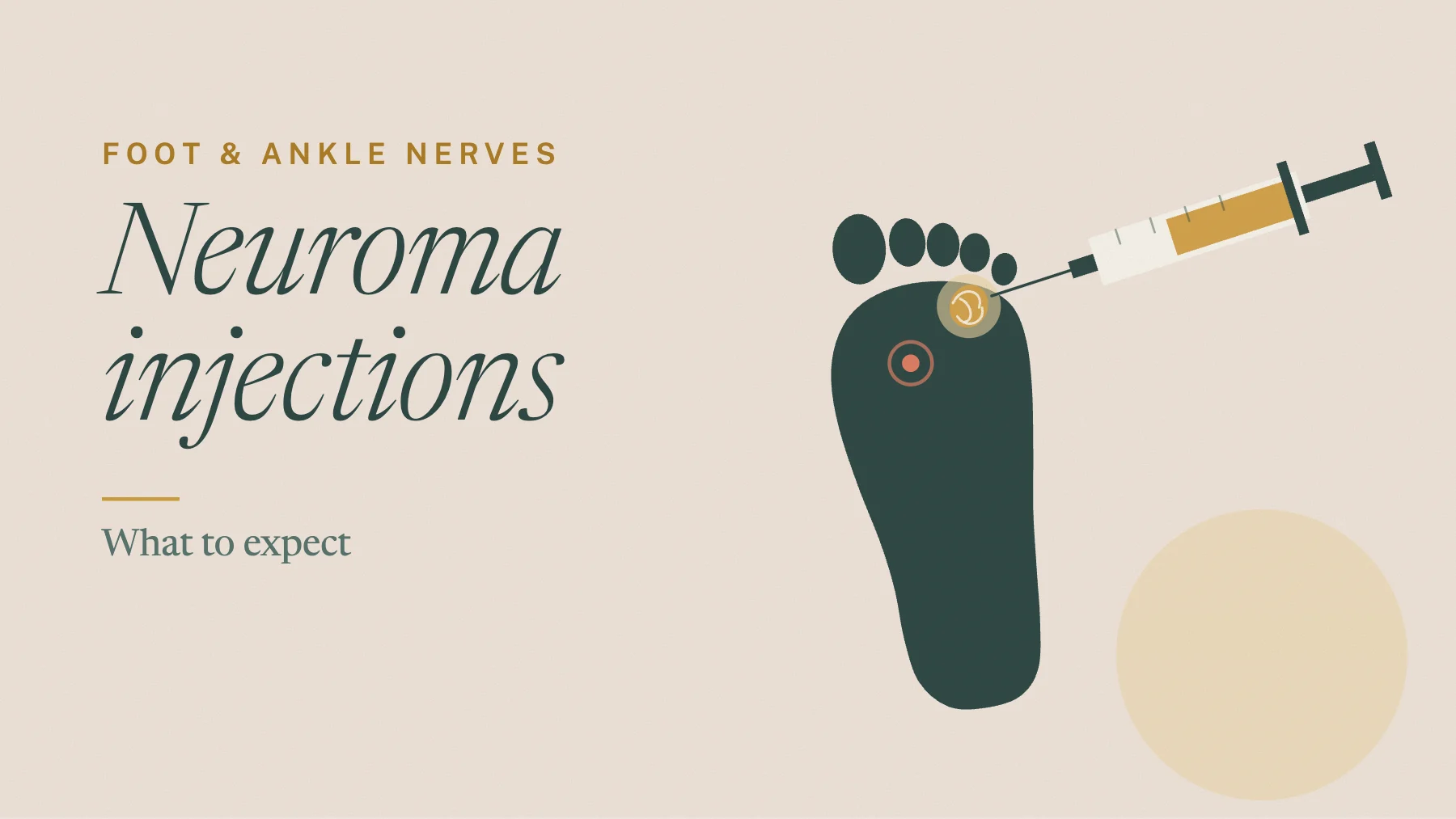
Morton’s neuroma injections: what to expect
What a steroid injection can and can’t do for Morton’s neuroma, how long relief lasts, and when surgery comes up.