Diagnosis guide
Back or foot? Finding the source of foot nerve pain
How to tell whether foot pain, numbness or tingling comes from the lower back or from a nerve in the foot.
Medically reviewed by Dr. Efe Ozturk · Last reviewed
One nerve pathway, many places for trouble
The nerves that supply your foot start in the lower spine. The nerve roots there join to form the sciatic nerve, which runs down the back of the thigh and divides near the knee into the tibial nerve and the peroneal nerve. These branches continue down the leg and split into the small nerves of the foot.[4]
That means a problem at any point along the way, in the spine, the buttock, the knee, the ankle or the foot, can produce symptoms in the foot. The brain reads the signal as coming from the foot, whichever spot is irritated.
Sciatica is pain that follows the path of the sciatic nerve or one of its roots, usually from the buttock down the back or side of the leg, sometimes into the foot. It is most often caused by a pinched nerve root in the lower back, for example from a herniated disc.[1,2] Foot nerve entrapment happens when a nerve is compressed further down, such as in the tarsal tunnel or between the toes in Morton’s neuroma.
Clues that point to the back or to the foot
These are tendencies, not rules, and they can overlap.
| Clue | More typical of the back | More typical of the foot or ankle |
|---|---|---|
| Where it starts | The back or buttock, then travels down the leg | In the foot or around the ankle |
| What brings it on | Sitting, bending, coughing or sneezing | Standing, walking, or particular shoes; often eases with shoes off |
| Tapping along the nerve | Usually no single tender spot in the foot | A spot where tapping sends tingling into the foot |
| Back or buttock pain | Often present, though not always | Usually absent |
| Weakness | May affect the muscles that lift the foot or push off | Less common, and usually limited to small muscles in the foot |
Symptoms in both feet, starting at the toes, point to a third possibility: peripheral neuropathy, a body-wide nerve condition. It can also occur together with either of the others.[5]
When both are involved
Sometimes a nerve is affected in two places at once, for example at the spine and again in the leg or foot. This is called double crush syndrome. The idea is debated, and some specialists question it. Still, a body-wide neuropathy or a second pinch point can coexist with the first problem, which may help explain less satisfying results after treatment at only one site.[3]
A recent case series described people with a pinched L5 nerve root and a compressed peroneal nerve at the knee. Some had both at the start. Others still had symptoms after their back was treated, and the peroneal nerve was found to be involved too. Releasing the peroneal nerve helped most of them, though the series was small and from a single center.[6]
The practical lesson is simple: when symptoms persist after treatment at one site, it is reasonable to look at the whole pathway again.
How the source is found
- History: where symptoms start, what provokes and relieves them, back or leg pain, injuries, surgery, and other health conditions.
- Examination of the whole leg, not just the foot: the back, hip and knee, movements that stretch the sciatic nerve, strength and reflexes, sensation, tapping along nerves, foot alignment and circulation.
- Nerve studies and EMG, which can show whether the trouble is at the nerve root, along the nerve in the leg, or in the foot.[7,8] These are performed by another specialist, and we coordinate them and review the results with you. See nerve testing for foot pain.
- Imaging such as an MRI of the lower back, or an ultrasound or MRI of a nerve or the foot. Scans are read together with the examination, because changes can appear on scans in people who have no symptoms.
What happens next
If the evidence points to the back, we’ll say so and help you reach the right care, such as your primary care physician, a spine specialist or a physical therapist. If it points to the foot, we’ll build a plan for the foot, starting with non-surgical care whenever it’s appropriate. If both are involved, we work with your other clinicians so that treating one doesn’t leave the other unaddressed.
When to seek care
Consider an evaluation if you have had foot pain, numbness or tingling for more than a few weeks and can’t tell whether your back or your foot is responsible, or if you’ve had treatment for your back or foot and still have symptoms.
References
- 1.Jensen RK, Kongsted A, Kjaer P, Koes B. Diagnosis and treatment of sciatica. BMJ. 2019;367:l6273. PubMed 31744805 (external site)
- 2.Ropper AH, Zafonte RD. Sciatica. N Engl J Med. 2015;372(13):1240-8. PubMed 25806916 (external site)
- 3.Kane PM, Daniels AH, Akelman E. Double Crush Syndrome. J Am Acad Orthop Surg. 2015;23(9):558-62. PubMed 26306807 (external site)
- 4.Lezak B, Massel DH, Varacallo MA. Peroneal Nerve Injury. In: StatPearls. StatPearls Publishing; updated 2024. PubMed 31751049 (external site)
- 5.Mauermann ML, Staff NP. Peripheral Neuropathy: A Review. JAMA. 2026;335(3):255-266. PubMed 41247746 (external site)
- 6.den Boogert HF, Schuuring J, de Ruiter GCW. Double Crush Syndrome of the L5 Nerve Root and Common Peroneal Nerve at the Fibular Head: A Case Series and Review of the Literature. J Clin Med. 2025;14(14). PubMed 40725716 (external site)
- 7.Patel AT, Gaines K, Malamut R, Park TA, Toro DR, Holland N, et al. Usefulness of electrodiagnostic techniques in the evaluation of suspected tarsal tunnel syndrome: an evidence-based review. Muscle Nerve. 2005;32(2):236-40. PubMed 16003732 (external site)
- 8.Carolus AE, Becker M, Cuny J, Smektala R, Schmieder K, Brenke C. The Interdisciplinary Management of Foot Drop. Dtsch Arztebl Int. 2019;116(20):347-354. PubMed 31288916 (external site)
This page is general health information and isn’t a substitute for advice from a clinician who knows your history. Read our medical disclaimer and how we review content.
Related topics
Condition
Foot drop
Weakness lifting the front of the foot, from a pinched nerve in the back or a compressed peroneal nerve near the knee.
Condition
Neuropathy evaluation
Evaluation of numbness, tingling or burning in both feet, with protective foot care and coordinated testing.
Diagnosis guide
Nerve testing
The examination, nerve conduction studies, EMG, ultrasound and MRI: what each shows and where each falls short.
Condition
Tarsal tunnel syndrome
Pressure on the tibial nerve at the inner ankle, causing burning, tingling or numbness in the sole.
Articles on this topic
Foot & ankle nerves
Common peroneal nerve entrapment: pain, numbness and when to release the nerve
Pressure on the nerve just below the outer knee can cause pain, numbness and a weak foot lift. What decompression surgery does for pain, strength and feeling, and why the clock matters.

Finding the cause
EMG and nerve conduction study: what to expect
What the tests measure, what they feel like, how to prepare, and why a normal result doesn’t always rule out a nerve problem.
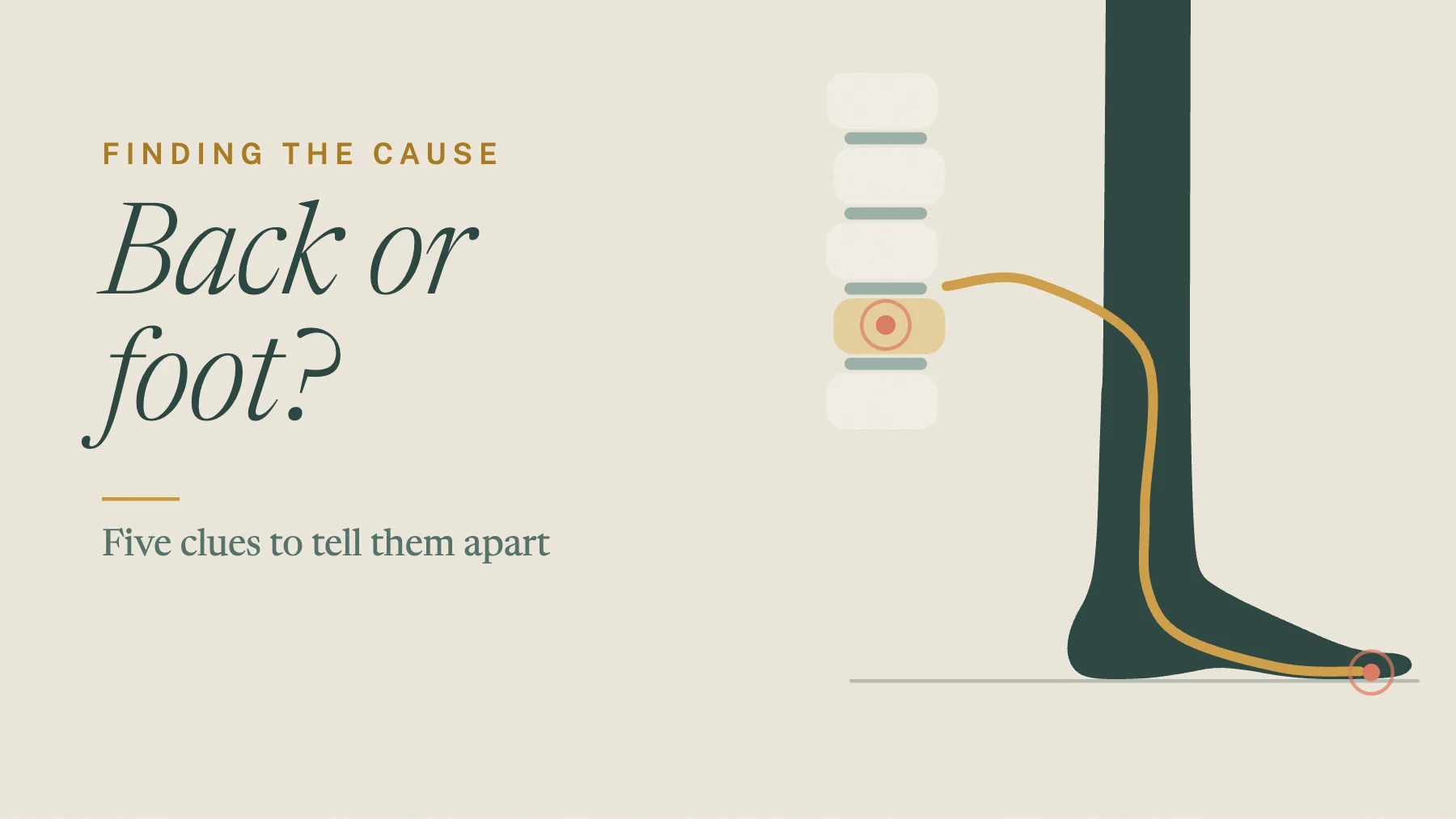
Finding the cause
Sciatica or a foot nerve problem? Five clues to tell them apart
Where it starts, what triggers it, and what a tap on the nerve does: five clues to whether your foot symptoms come from the back or the foot.