Treatment
Nerve repair and reconstruction
Surgery to repair or reconstruct a nerve that has been cut or badly injured, or to manage a painful nerve end.
Medically reviewed by Dr. Efe Ozturk · Last reviewed
When is nerve repair considered?
- A nerve cut by an injury, such as a laceration on the top or side of the foot.
- A nerve damaged during an operation, when numbness or nerve pain in a specific area points to an injured nerve.
- A painful neuroma — a tangle of nerve fibres at an injured nerve end — especially when the other end of the nerve can be found and reconnected. See nerve pain after surgery or injury.
- A nerve trapped in scar tissue, where freeing it may be combined with repair of a damaged segment.
Most of the nerves involved in the foot and ankle are sensory nerves, which supply feeling to the skin. Repairing them aims to reduce pain and restore some protective sensation.
How nerve injuries differ
Nerve injuries range from mild to severe:[1]
- Bruised or compressed — the nerve is intact and usually recovers over weeks to a few months.
- Internal damage with the outer sheath intact — the nerve fibres can regrow along their original path, and recovery may take many months.
- Completely cut — the nerve fibres cannot find their way back without surgery.
A careful examination, your history and, when helpful, imaging or nerve studies arranged with another specialist help decide which kind of injury is present and whether surgery could help.
Surgical options
- Direct repair. The two nerve ends are trimmed and sewn together under magnification, without tension.
- Nerve graft. When there is a gap, it can be bridged with a segment of a small sensory nerve taken from elsewhere in your body (an autograft, which leaves a small numb area where it was taken) or with a processed donor nerve (an allograft).
- Conduit. A hollow tube that guides regrowing nerve fibres across a short gap.
- Managing a painful nerve end. When the nerve end can’t be reconnected, options include removing the neuroma and relocating the nerve end into muscle or bone, or giving the nerve a “target” to grow into so a painful neuroma is less likely to re-form.[4]
A 2023 meta-analysis found similar rates of meaningful recovery with a patient’s own nerve graft and with a processed donor nerve. For short sensory gaps, conduits had lower recovery rates and more pain-related complications.[3] For painful neuromas, a pooled analysis of published studies found meaningful pain reduction in about three-quarters of patients overall, with no single technique clearly best; study quality varied.[5]
Timing
For a cleanly cut nerve, repair is often recommended soon after the injury, when the ends can usually be brought together more easily. Repair can still be considered later, but the approach may change — for example, a graft may be needed — and the expected recovery may be less complete. The right timing depends on the nerve, the type of injury and your overall health.[2]
Recovery and realistic expectations
- Regrowth is slow. After repair, nerve fibres regrow gradually from the repair site toward the skin — commonly estimated at about a millimetre a day — so recovery is measured in months.[6]
- Sensations change as the nerve regrows. Tingling or “electric” feelings that move gradually down the foot can be a sign of regrowth.
- Protect numb skin from pressure, heat and injury while feeling returns.
- Desensitization therapy can help with an over-sensitive area.
- Results vary. The goal is meaningful improvement in pain and protective sensation; normal feeling may not return completely.
Risks
Risks discussed before nerve repair include infection and wound-healing problems; persistent pain or a new painful neuroma; numbness at a graft donor site; incomplete recovery of feeling; blood clots; and the possibility of needing further surgery. See also revision nerve surgery.
When to seek care
Consider an evaluation if you have numbness, burning or electric pain in part of your foot after an injury or operation that isn’t improving, or if you have a cut on your foot or ankle followed by numbness beyond the wound.
References
- 1.Nadi M, Dabbas W, Das JM. Peripheral Nerve Injury. In: StatPearls. StatPearls Publishing; updated 2026. PubMed 31751038 (external site)
- 2.MacKay BJ, Cox CT, Valerio IL, et al. Evidence-based approach to timing of nerve surgery: a review. Ann Plast Surg. 2021;87(3):e1-e21. PubMed 33833177 (external site)
- 3.Lans J, Eberlin KR, Evans PJ, Mercer D, Greenberg JA, Styron JF. A systematic review and meta-analysis of nerve gap repair: comparative effectiveness of allografts, autografts, and conduits. Plast Reconstr Surg. 2023;151(5):814e-827e. PubMed 36728885 (external site)
- 4.Eberlin KR, Ducic I. Surgical algorithm for neuroma management: a changing treatment paradigm. Plast Reconstr Surg Glob Open. 2018;6(10):e1952. PubMed 30534497 (external site)
- 5.Poppler LH, Parikh RP, Bichanich MJ, et al. Surgical interventions for the treatment of painful neuroma: a comparative meta-analysis. Pain. 2018;159(2):214-223. PubMed 29189515 (external site)
- 6.Bamba R, Riley DC, Kelm ND, Does MD, Dortch RD, Thayer WP. A novel technique using hydrophilic polymers to promote axonal fusion. Neural Regen Res. 2016;11(4):525-528. PubMed 27212898 (external site)
This page is general health information and isn’t a substitute for advice from a clinician who knows your history. Read our medical disclaimer and how we review content.
Related topics
Condition
After surgery or injury
Burning, shooting or electric pain that begins after an injury or an operation on the foot or ankle.
Treatment
Revision nerve surgery
A further operation for nerve symptoms that persist or return after previous neuroma or nerve-release surgery.
Treatment
Neuroma treatment
Stepwise care for Morton’s neuroma and other painful neuromas, from footwear changes to surgery.
Articles on this topic
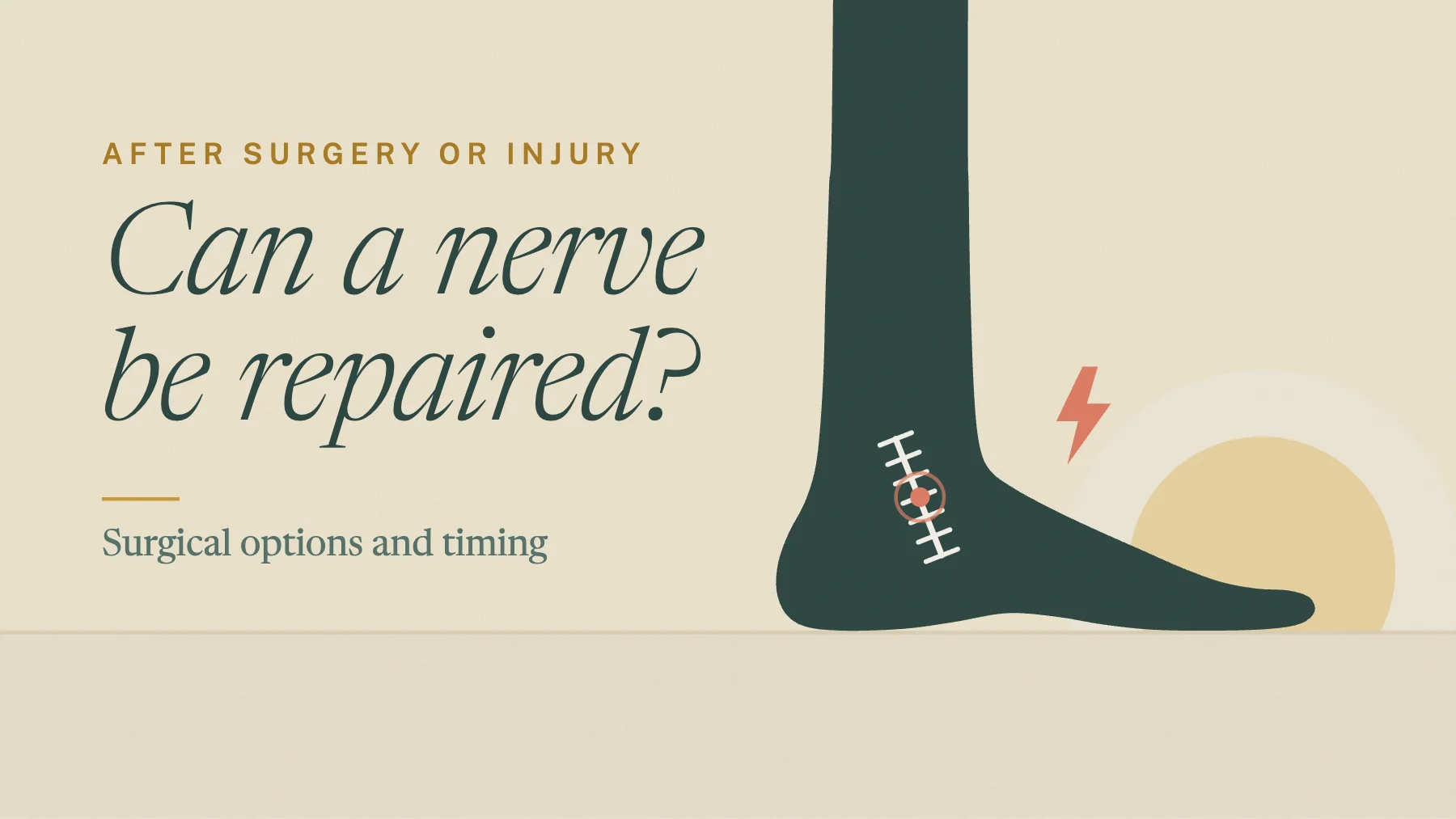
After surgery or injury
Can nerve damage in the foot be repaired? Your surgical options
Often, yes. How surgeons match the injury to the repair, how fast nerves regrow, and why the calendar matters more for muscle than for feeling.
Finding the cause
When to get a second opinion for foot nerve pain
When a second opinion makes sense, why nerve pain can persist after surgery, and what a fresh evaluation should include.