Small fiber neuropathy: burning feet with normal tests
Burning feet but normal nerve tests? What small fiber neuropathy is and how it is found.

By Efe Ozturk, DPM · 4 min read
Medically reviewed by Efe Ozturk, DPM · Last reviewed
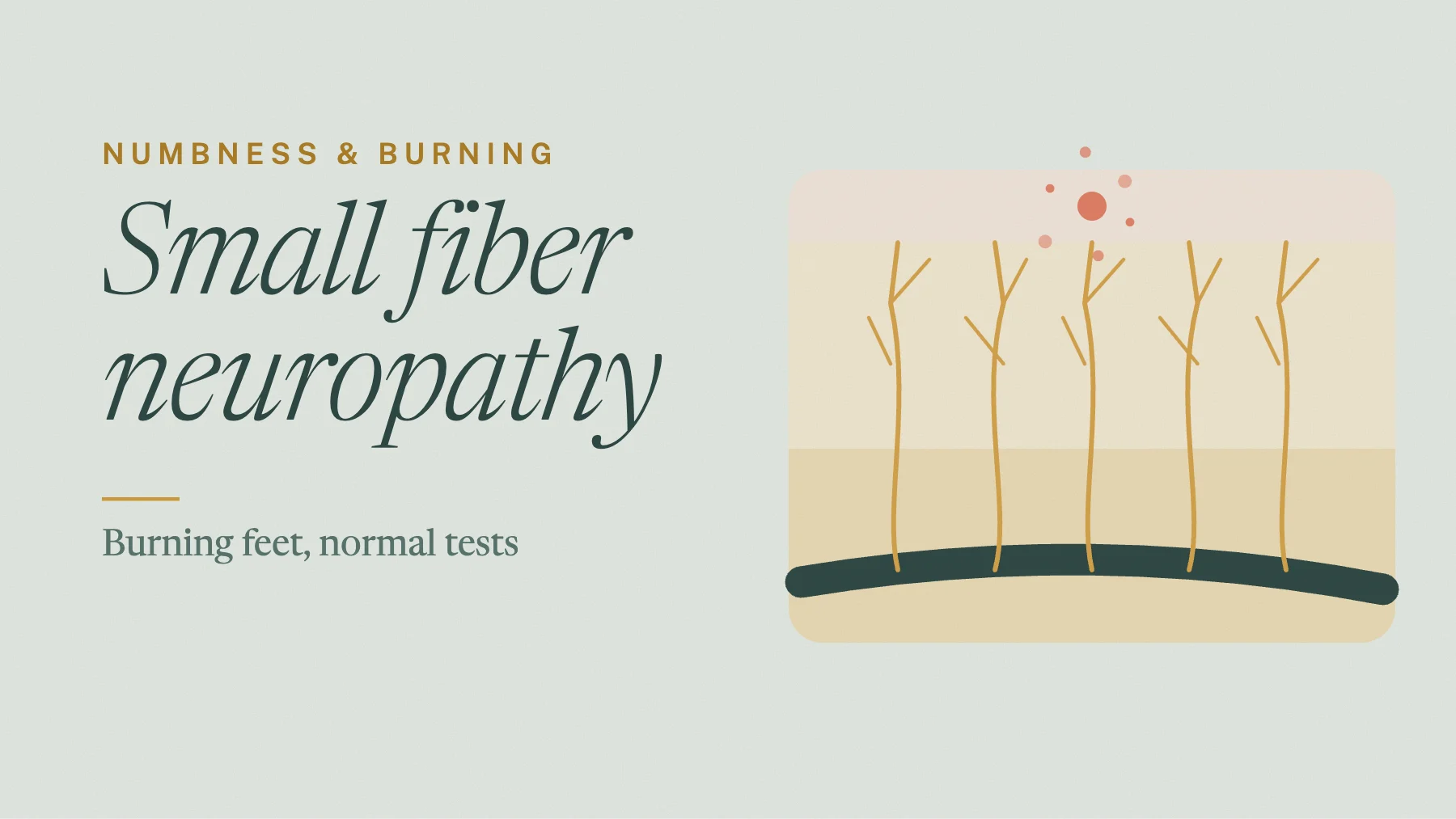
Your feet burn, tingle or sting. Your doctor examines you and orders a nerve conduction study, and it comes back normal. It is easy to walk away feeling that nothing is wrong. But a normal result doesn’t always mean normal nerves, and one explanation is damage to the smallest fibers, which the standard test may not pick up.
What small fibers are
Small fiber neuropathy is a group of disorders affecting the thin myelinated A-delta fibers and the unmyelinated C fibers. The typical presentation is a length-dependent polyneuropathy, which means it starts in the feet and creeps upward, although other patterns occur.[1] Common symptoms are neuropathic pain and autonomic disturbances.[1]
Why tests can be normal
Patients with lower extremity sensory symptoms and pain, but without abnormalities on the clinical examination or on standard neurophysiological testing, may have a small fiber neuropathy.[2] Standard nerve conduction studies and EMG are the tests most people have first. They are valuable for other problems, such as a pinched nerve or a large-fiber neuropathy. Our guide to normal EMG but still nerve pain explains the limits of those tests.
How it is diagnosed
Diagnosis combines your symptoms and signs with specific tests:
- Skin biopsy. A tiny sample of skin is examined to count nerve fibers. In the review cited above, a retrospective study found reduced fiber density in 88.1% of 67 people with sensory symptoms and normal nerve conduction studies, compared with 10% of healthy controls. The biopsy was more often abnormal than the clinical examination or quantitative sensory testing in that setting.[2] The reviewers said the research still needs to be done better, since some studies included the tests in the definition of the condition.[2]
- Guideline support. A 2023 joint guideline gave a strong recommendation to skin biopsy and a weak recommendation to quantitative sensory testing for diagnosing neuropathic pain.[3]
- Looking for a cause. A systematic approach to causes includes laboratory tests and, for some people, genetic examinations.[1] A JAMA review of peripheral neuropathy suggests starting with blood sugar, vitamin B12 and its related markers, and a protein test for certain blood disorders.[5]
Skin biopsy and related testing are arranged with a neurologist, since they are not done in a foot and ankle office. We coordinate them and review the results with you. See nerve testing for foot pain.
What can be done
- Treat the cause if one is found, such as blood-sugar control in diabetes or correcting a vitamin B12 shortage.[1] Many people don’t have a cause found. In up to 27% of adults with neuropathy in general, no cause is identified after testing.[5]
- Treat the pain. First-line medicines for neuropathic pain include gabapentin and pregabalin, duloxetine and venlafaxine, and tricyclic antidepressants.[5] In pooled trials, roughly one in six to eight people taking them got at least 50% pain relief beyond what a placebo gave.[4] These are prescribed and monitored by your physician or neurologist.
- Protect your feet, because reduced feeling makes injuries easy to miss, and wear roomy shoes.
For the broader symptom picture, see burning feet at night and burning feet.
When a foot nerve specialist helps
Burning feet that point to small fibers still deserve a check for a second, treatable problem. A pinched nerve in the foot or ankle can coexist with a neuropathy, and a neuropathy can be mistaken for a pinched nerve. A foot-focused evaluation helps sort out which is which, and we work alongside your primary care physician or neurologist.
When to see a specialist
Book an evaluation if burning in your feet has lasted more than a few weeks, is worsening or climbing upward, or is costing you sleep, especially if earlier tests came back normal. With diabetes, don’t wait for new burning or numbness to settle on its own.

About the author
Efe Ozturk, DPM
Foot and Ankle Surgeon. Dr. Ozturk is double board certified, as a Diplomate of the American Board of Podiatric Medicine (DABPM) and a Fellow of the Academy of Physicians in Wound Healing (FAPWH), and is a Fellow of the American Society of Podiatric Surgeons (FASPS) and the American Society of Podiatric Medicine (FASPM). He leads the Lower Extremity Nerve Institute, a specialty practice of Ozturk Foot & Ankle, and sees patients in Lyndhurst, Paramus and Millburn, New Jersey.
References
- 1.Devigili G, Cazzato D, Lauria G. Clinical diagnosis and management of small fiber neuropathy: an update on best practice. Expert Rev Neurother. 2020;20(9):967-980. PubMed 32654574 (external site)
- 2.Hlubocky A, Wellik K, Ross MA, et al. Skin biopsy for diagnosis of small fiber neuropathy: a critically appraised topic. Neurologist. 2010;16(1):61-3. PubMed 20065802 (external site)
- 3.Truini A, Aleksovska K, Anderson CC, et al. Joint European Academy of Neurology-European Pain Federation-Neuropathic Pain Special Interest Group of the International Association for the Study of Pain guidelines on neuropathic pain assessment. Eur J Neurol. 2023;30(8):2177-2196. PubMed 37253688 (external site)
- 4.Finnerup NB, Attal N, Haroutounian S, McNicol E, Baron R, Dworkin RH, et al. Pharmacotherapy for neuropathic pain in adults: a systematic review and meta-analysis. Lancet Neurol. 2015;14(2):162-73. PubMed 25575710 (external site)
- 5.Mauermann ML, Staff NP. Peripheral Neuropathy: A Review. JAMA. 2026;335(3):255-266. PubMed 41247746 (external site)
This article is general health information and isn’t a substitute for advice from a clinician who knows your history. Read our medical disclaimer and how we review content.
More from the blog
Numbness & burning
Burning feet at night: causes and what can help
Burning feet have many possible causes. How doctors sort them out, what can help, and when it needs checking.
Numbness & burning
Diabetic neuropathy in the feet: when to see a nerve specialist
How diabetic neuropathy is diagnosed, how to protect numb feet, and the signs that point to something else.
Numbness & burning
Numbness in only one foot: what it can mean
One numb foot points to a different set of causes than two. The patterns, and when to get it checked.