Nerve pain after ankle surgery: what’s normal and what isn’t
Numbness near a scar is common; burning, electric pain is a reason to ask. What’s expected, what the research shows and what can help.

By Dr. Efe Ozturk · 4 min read
Medically reviewed by Dr. Efe Ozturk · Last reviewed
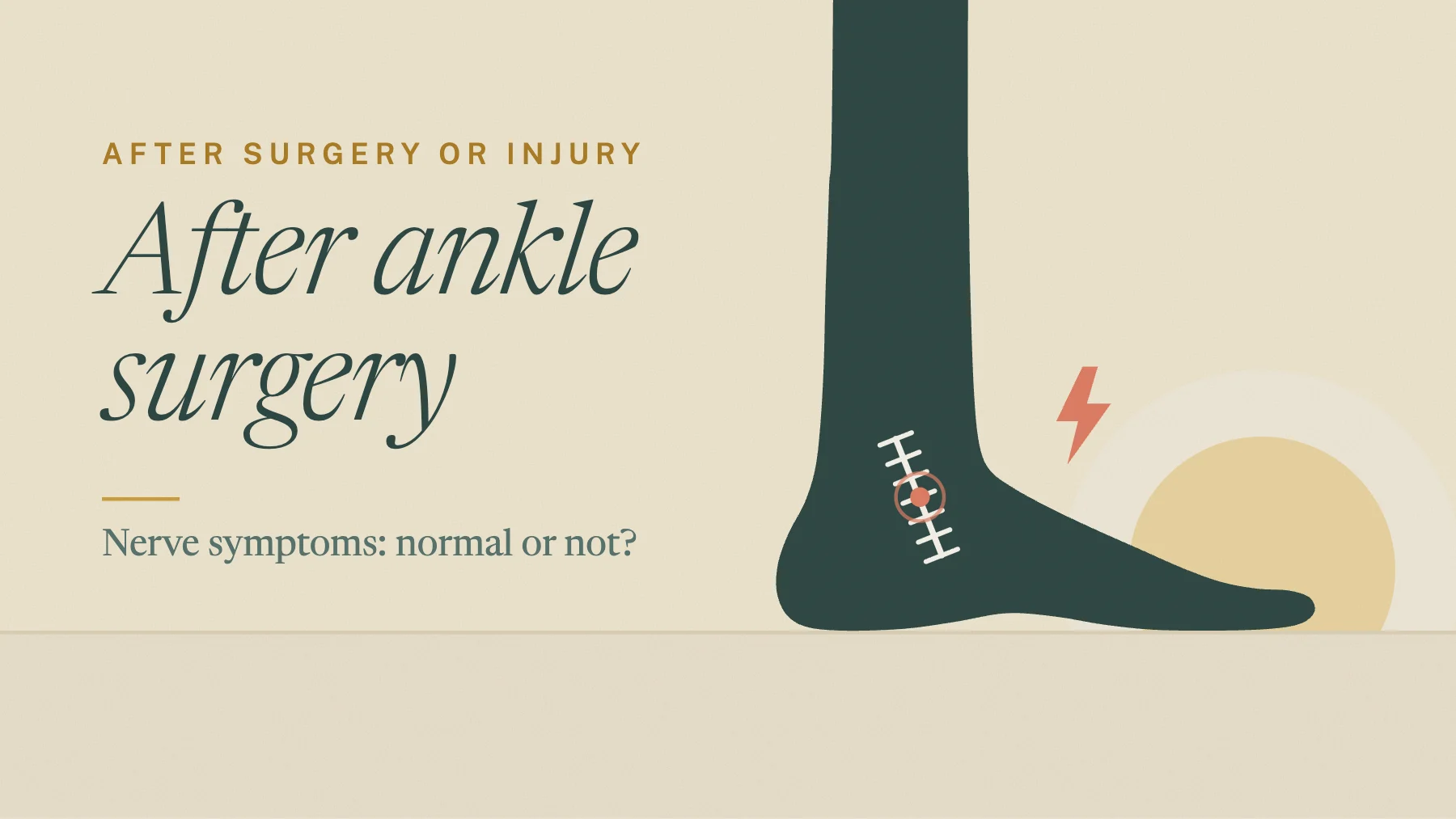
Some numbness or tingling around a scar is a common part of recovery from foot and ankle surgery. But sometimes the sensation is stronger than numbness: burning, electric zings, or a patch of skin that hurts when a sock touches it. If that is you, it helps to know what is expected, what isn’t, and what can be done.
Why the nerves near the ankle are vulnerable
Sensory nerves run just under the skin around the ankle and foot, close to where injuries happen and where incisions are made. A nerve can be:[1,2]
- stretched or bruised, for example in a sprain or fracture, which often recover over weeks to months
- compressed by swelling, a cast, splint or boot, or later by scar tissue that tethers the nerve
- partly or completely cut, in which case the nerve tries to regrow and a tangle of nerve fibers called a neuroma can form at the injured end
After ankle procedures, the nerves most often involved are the superficial peroneal nerve at the front of the ankle and the sural nerve on the outer side.[3] Small nerves on the inner ankle and in the toes can be affected too.
What a large study found
A single-center study followed 545 consecutive ankle and hindfoot arthroscopies. Its main findings:[3]
- Nerve complications involving the superficial peroneal or sural nerve occurred in 46 procedures (8.4%).
- The superficial peroneal nerve was involved most often (65%), then the sural nerve (24%).
- In about two-thirds of cases, symptoms began within 48 hours of the operation.
- At an average follow-up of 13 months, 84% reported progressive improvement, but only 44% had complete resolution.
- Smoking and the surgical approach were linked to a higher risk of complications.
- People with higher leftover pain and nerve-pain features were less likely to recover on their own.
The authors described recovery as taking longer than traditionally assumed, and said the findings support early recognition of nerve-type symptoms.[3] That is a study of arthroscopy, but the lesson carries over: nerve recovery is slow, and it is often incomplete.
Normal recovery, or a reason to call?
Some numbness near an incision is common and often improves gradually over months. These signs deserve an evaluation:
- burning, electric or shooting pain near or beyond the scar
- pain that is increasing rather than settling
- a tender spot that sends a “zing” into the foot when you tap it
- sensitivity to light touch, socks, bed sheets or shoes
- numbness that is spreading
- pain that seems out of proportion to how the wound looks
Pain along with changes in skin color or temperature, swelling, sweating, or changes in hair or nail growth can signal complex regional pain syndrome (CRPS), which benefits from early recognition. CRPS is a pain disorder in which the pain is out of proportion to the injury and continues beyond the usual healing time. It often develops after trauma, a fracture or surgery.[5,6] If you notice this pattern, don’t wait to be seen.
What can help
Treatment usually starts without another operation:
- Time and protection, since many nerve injuries improve gradually.
- Desensitization: a structured program, often with a physical or occupational therapist, to calm an over-sensitive area.
- Footwear and padding to keep pressure off the sore spot.
- Medicine for nerve pain, including topical treatments, coordinated with your primary care physician or a pain specialist.
- Injection in selected cases.
We explain these in non-surgical treatment for nerve pain.
When pain persists despite well-tried non-surgical care and a specific injured nerve has been clearly identified, surgery for a painful neuroma may be considered. Approaches include removing the neuroma and placing the nerve end where it is protected, freeing a nerve from scar tissue, and reconstructing the nerve. Newer techniques aim to give the regrowing nerve a target so a painful neuroma is less likely to re-form.[2] A pooled analysis of 54 studies found that surgery led to a meaningful reduction in pain in about 77% of patients overall, though the studies varied in quality and few controlled for other factors.[4] See painful neuroma and neuroma surgery.
Make your visit more useful
- Ask your surgeon for the operative report, and bring imaging and any previous test results.
- Note when the symptoms began and how they have changed.
- Describe the pain in your own words. Our guide on how to describe nerve pain can help.
If you have been told your pain “should have settled by now,” or you still have nerve symptoms after a previous operation, a second opinion can help clarify what is going on. See nerve pain after surgery or injury and revision nerve surgery.
When to see a specialist
Consider an evaluation if burning, electric or shooting pain after an injury or operation lasts more than a few weeks, is getting worse, or keeps you from wearing shoes or sleeping.
About the author
Dr. Efe Ozturk
Foot and Ankle Surgeon. Dr. Ozturk is double board certified, as a Diplomate of the American Board of Podiatric Medicine (DABPM) and a Fellow of the Academy of Physicians in Wound Healing (FAPWH), and is a Fellow of the American Society of Podiatric Surgeons (FASPS) and the American Society of Podiatric Medicine (FASPM). He leads the Lower Extremity Nerve Institute, a specialty practice of Ozturk Foot & Ankle, and sees patients in Lyndhurst, Paramus and Millburn, New Jersey.
References
- 1.Pomeroy G, Wilton J, Anthony S. Entrapment neuropathy about the foot and ankle: an update. J Am Acad Orthop Surg. 2015;23(1):58-66. PubMed 25538131 (external site)
- 2.Eberlin KR, Ducic I. Surgical algorithm for neuroma management: a changing treatment paradigm. Plast Reconstr Surg Glob Open. 2018;6(10):e1952. PubMed 30534497 (external site)
- 3.Roche D, Lopes R. Postoperative sensory nerve complications following ankle arthroscopy: incidence, risk factors, and clinical course in 545 consecutive procedures. Foot Ankle Int. 2026;47(9):1137-1147. PubMed 42500939 (external site)
- 4.Poppler LH, Parikh RP, Bichanich MJ, et al. Surgical interventions for the treatment of painful neuroma: a comparative meta-analysis. Pain. 2018;159(2):214-223. PubMed 29189515 (external site)
- 5.National Institute of Neurological Disorders and Stroke. Complex Regional Pain Syndrome. ninds.nih.gov (external site)
- 6.Guthmiller KB, Dua A, Dey S, Varacallo MA. Complex Regional Pain Syndrome. In: StatPearls. StatPearls Publishing; updated 2025. PubMed 28613470 (external site)
This article is general health information and isn’t a substitute for advice from a clinician who knows your history. Read our medical disclaimer and how we review content.
More from the blog
After surgery or injury
Foot drop after surgery: what it means and what to do next
Toes catching after an operation? Why foot drop happens, how common it is, what to do right away, and what recovery can look like.
After surgery or injury
Nerve pain at the front of the knee after knee replacement
When the implant looks fine but the front of the knee burns, a small nerve may be the cause. The clues and the options.
After surgery or injury
Nerve pain after Achilles surgery: the sural nerve
How often the sural nerve is affected after Achilles repair, what it feels like, and what can be done.