Numbness or burning after an ankle sprain: when the injury stretched a nerve too
An inversion sprain can stretch the peroneal and sural nerves along with the ligaments. Stretched nerves can recover within weeks; when numbness or burning lasts, a nerve release, neuroma surgery or ligament repair can help.

By Dr. Efe Ozturk · 6 min read
Medically reviewed by Dr. Efe Ozturk · Last reviewed
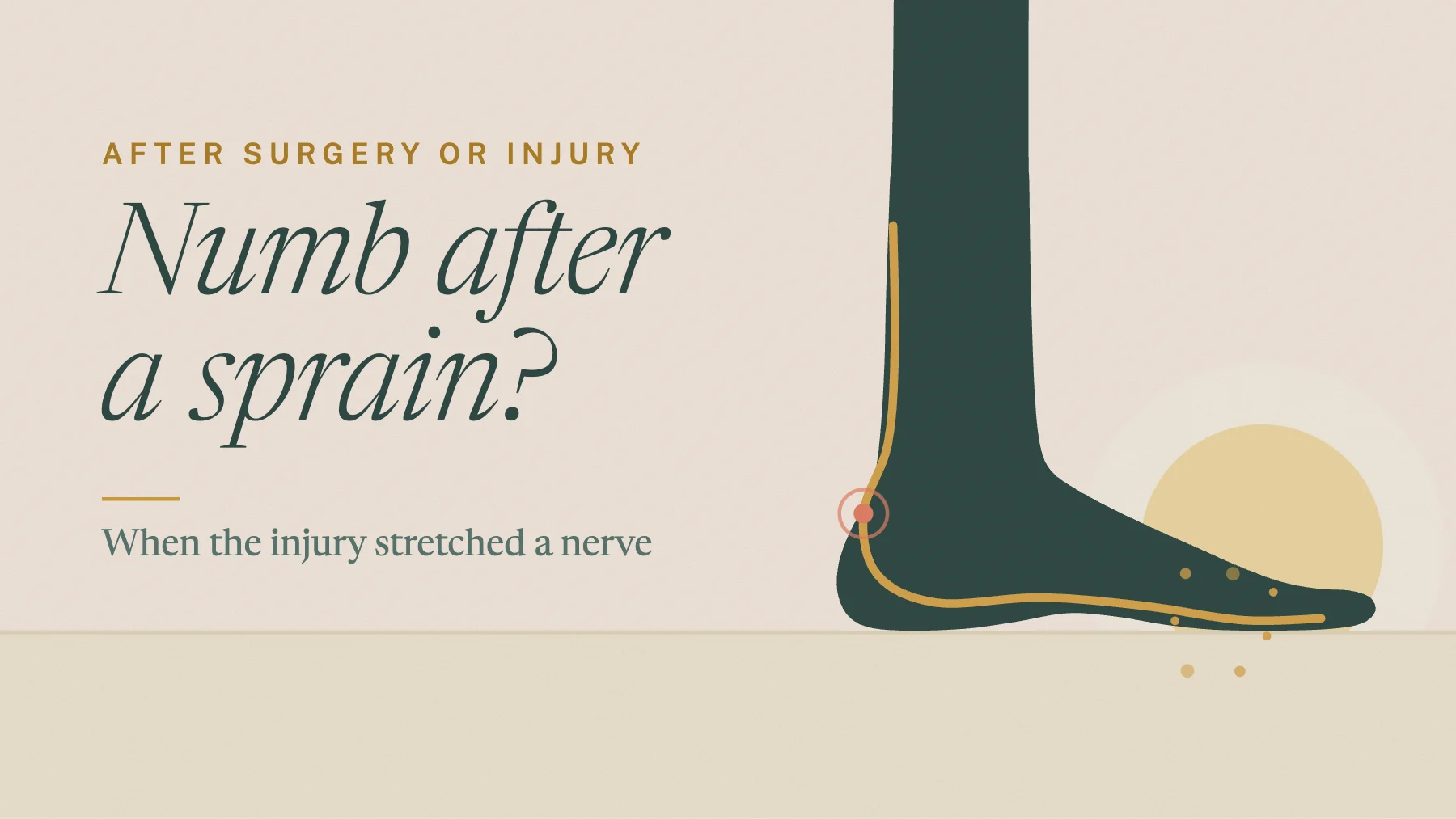
A sprained ankle should swell, bruise and ache. A numb top of the foot, a tingling outer edge or a burning that feels nothing like a bruise are nerve symptoms. A Foot and Ankle Surgeon can usually tell which nerve is involved and what will fix it.
Ankle sprains in the news this week
Two NBA players have missed games with sprained right ankles. The Washington Wizards’ Anthony Davis has missed two games with a right ankle sprain and was listed as questionable for Monday’s game against Detroit.[7,8] The Cleveland Cavaliers’ Jaylon Tyson was ruled out of Monday’s game against Charlotte, his sixth straight missed game.[9]
Neither player has been reported to have any nerve symptoms. We have no connection with either player or team and have not examined them. This is based on public reports as of the morning of November 9, 2026.
Can an ankle sprain cause nerve damage?
Yes. In a typical sprain the foot rolls inward (an inversion sprain). That stretches the ligaments on the outer ankle, and it can also pull on the nerves that run down the leg.
- Severe sprains. In 66 people tested with EMG two weeks after a sprain, 17% of moderate (grade II) sprains and 86% of severe (grade III) sprains showed peroneal nerve injury. The tibial nerve was injured in 83% of severe sprains. The authors thought a mild stretch (traction) injury, or bleeding inside the nerve’s covering, was the likely cause.[1]
- Both peroneal branches. In 22 people, nerve signals were slower in both the superficial and deep peroneal nerves within about a week of an inversion injury.[2]
- The outer foot. The sural nerve is at risk of traction in severe inversion injuries.[10]
Each nerve leaves its own pattern. The superficial peroneal nerve gives feeling to most of the top of the foot. It is most often trapped where it comes out of the outer leg muscles.[5] A trapped deep peroneal nerve typically sends pain into the web space between the big and second toes.[11] The sural nerve covers the outer edge of the foot. Read more about superficial peroneal nerve entrapment and numbness on the outside of the foot.
Nerve pain or ligament pain: how do you tell?
Ligament pain is usually an ache at the outer ankle that is worse when you stand or walk, with swelling, bruising and sometimes a giving-way feeling.
Nerve pain burns, zings or buzzes like pins and needles. The skin can go numb or become so sensitive that a sock hurts. It often spreads into the foot or toes, and tapping over the nerve may set off a tingle.
Ligament tests don’t answer the nerve question. In the nerve study above, slowed nerve signals did not match the results of hands-on ligament looseness tests.[2]
A careful exam of strength, feeling and walking is the core of the diagnosis. Nerve conduction studies, EMG and diagnostic nerve blocks can help.[5] We arrange those with another specialist and review the results with you. Ultrasound can show ligament, tendon and nerve injuries after an ankle injury, and the practice has on-site X-ray and ultrasound.[12]
Does numbness after an ankle sprain go away?
Usually, yes. Clinical measures were back to normal within two weeks after moderate sprains. After severe sprains, return to full activity took about five weeks.[1] The superficial peroneal nerve recovered by five weeks, but the deep peroneal nerve was still slow at that point.[2] Many peroneal nerve entrapments settle with time and activity changes.[5]
Some don’t. Among 122 severe sprains in children, five led to scarring around the superficial peroneal nerve with symptoms lasting more than three months.[6] Peroneal nerve weakness can also appear later. Experts advise checking nerve function at follow-up visits, even when it was normal at first.[13]
Nerve damage after an ankle sprain: when is surgery the answer?
When the nerve is trapped in scar or has formed a painful knot, surgery can fix it. Dr. Efe Ozturk, a double board certified Foot and Ankle Surgeon and podiatrist, performs these operations for appropriate patients.
- Releasing the nerve (neurolysis or decompression). In 17 people with a trapped superficial peroneal nerve (a study not limited to sprains), 80% were free of symptoms or satisfied after surgery to free it.[3] In five children with scarring after a sprain, releasing the nerve and repairing the ligaments raised foot scores from 57.6 to 98.6 out of 100.[6] See nerve decompression.
- Removing a painful neuroma. A neuroma is a painful tangle of nerve fibers where a nerve was injured. Across 54 studies of neuromas in the arms and legs (not Morton’s neuroma), surgery gave meaningful pain relief in 77% of people.[4] When the sural nerve was cut back and its end placed in muscle, median pain fell from 9 to 3 out of 10.[10] See neuroma surgery.
- Stabilizing the ankle. Giving an unstable joint stability is a first-line step for peroneal nerve problems.[5] A year after a first sprain, 8.1% of people still felt the ankle was unstable and 15.8% had sprained it again.[14] In 408 people who had a Broström ligament repair, average ankle scores one year later were 80 to 89 out of 100.[15] Our surgical center explains chronic ankle instability (external site) and how it is repaired.
What can you do first?
Non-surgical care is the first step and often the bridge to recovery. Exercise and bracing are backed by stronger evidence than other sprain treatments.[16] Loosen laces or skip eyelets that press on a tender spot. Our main practice covers the ligament side in sprained ankle recovery (external site).
What are the limits?
The EMG study is from 1985, and the release and neuroma studies are small, with no comparison groups.[1,3,10] The neuroma review found that studies reported results in very different ways.[4] True nerve weakness (palsy) after a sprain is rare, with few cases reported.[13] A pooled review of first sprains suggests a longer period of non-surgical care before ligament surgery, since pain and instability keep improving for up to a year.[14]
Common questions
Is tingling after an ankle sprain normal?
It can happen, especially after a severe sprain. Nerve testing found peroneal nerve changes after most severe sprains.[1] In one study, superficial peroneal nerve signals were back to normal by five weeks.[2]
Why are my toes numb after an ankle sprain?
Pain that shoots into the space between the big and second toes points to the deep peroneal nerve.[11] Numbness on the rest of the top of the foot fits the superficial peroneal nerve.
What is the treatment for nerve damage after an ankle sprain?
Start with rehab, bracing and removing pressure. If symptoms last for months, a nerve release, neuroma surgery or ligament repair can help.[5,4] See nerve pain after surgery or injury.
When to see a specialist
Book an evaluation if numbness, tingling or burning lasts more than a few weeks after a sprain, keeps coming back each time the ankle rolls, or gets worse instead of better. We see patients in Lyndhurst, Paramus and Millburn. Please call our office at 908-215-5953 to inquire about your insurance.

About the author
Dr. Efe Ozturk
Foot and Ankle Surgeon. Dr. Ozturk is double board certified, as a Diplomate of the American Board of Podiatric Medicine (DABPM) and a Fellow of the Academy of Physicians in Wound Healing (FAPWH), and is a Fellow of the American Society of Podiatric Surgeons (FASPS) and the American Society of Podiatric Medicine (FASPM). He leads the Lower Extremity Nerve Institute, a specialty practice of Ozturk Foot & Ankle, and sees patients in Lyndhurst, Paramus and Millburn, New Jersey.
References
- 1.Nitz AJ, Dobner JJ, Kersey D. Nerve injury and grades II and III ankle sprains. Am J Sports Med. 1985;13(3):177-182. PubMed 4014532 (external site)
- 2.Kleinrensink GJ, Stoeckart R, Meulstee J, et al. Lowered motor conduction velocity of the peroneal nerve after inversion trauma. Med Sci Sports Exerc. 1994;26(7):877-883. PubMed 7934762 (external site)
- 3.Styf J, Morberg P. The superficial peroneal tunnel syndrome. Results of treatment by decompression. J Bone Joint Surg Br. 1997;79(5):801-803. PubMed 9331039 (external site)
- 4.Poppler LH, Parikh RP, Bichanich MJ, et al. Surgical interventions for the treatment of painful neuroma: a comparative meta-analysis. Pain. 2018;159(2):214-223. PubMed 29189515 (external site)
- 5.Fortier LM, Markel M, Thomas BG, Sherman WF, Thomas BH, Kaye AD. An update on peroneal nerve entrapment and neuropathy. Orthop Rev (Pavia). 2021;13(2):24937. PubMed 34745471 (external site)
- 6.Falciglia F, Basiglini L, Aulisa AG, Toniolo RM. Superficial peroneal nerve entrapment in ankle sprain in childhood and adolescence. Sci Rep. 2021;11(1):15123. PubMed 34302026 (external site)
- 7.Johnson R. Anthony Davis (ankle) questionable Monday vs. DET. NBC Sports. November 8, 2026. nbcsports.com (external site)
- 8.Anderson EC. Washington Wizards announce Anthony Davis injury before Pistons game. Heavy. November 8, 2026. heavy.com (external site)
- 9.Johnson R. Jaylon Tyson (ankle) ruled out Monday vs. Hornets. NBC Sports. November 8, 2026. nbcsports.com (external site)
- 10.Cychosz CC, Eisenberg J, Glass N, et al. Outcomes of surgical treatment for sural neuritis: a retrospective case series. Foot Ankle Int. 2023;44(9):845-853. PubMed 37477149 (external site)
- 11.Ferkel E, Davis WH, Ellington JK. Entrapment neuropathies of the foot and ankle. Clin Sports Med. 2015;34(4):791-801. PubMed 26409596 (external site)
- 12.Jeevika, Chaudhary SR. Why ultrasound is the missing piece of the puzzle in the imaging and management pathway of acute ankle injuries. Clin Imaging. 2025;125:110554. PubMed 40628171 (external site)
- 13.Mitsiokapa E, Mavrogenis AF, Drakopoulos D, Mauffrey C, Scarlat M. Peroneal nerve palsy after ankle sprain: an update. Eur J Orthop Surg Traumatol. 2017;27(1):53-60. PubMed 27581424 (external site)
- 14.Michels F, Wastyn H, Pottel H, Stockmans F, Vereecke E, Matricali G. The presence of persistent symptoms 12 months following a first lateral ankle sprain: a systematic review and meta-analysis. Foot Ankle Surg. 2022;28(7):817-826. PubMed 34961654 (external site)
- 15.Attia AK, Taha T, Mahmoud K, Hunt KJ, Labib SA, d’Hooghe P. Outcomes of open versus arthroscopic Broström surgery for chronic lateral ankle instability: a systematic review and meta-analysis of comparative studies. Orthop J Sports Med. 2021;9(7):23259671211015207. PubMed 34368381 (external site)
- 16.Halabchi F, Hassabi M. Acute ankle sprain in athletes: clinical aspects and algorithmic approach. World J Orthop. 2020;11(12):534-558. PubMed 33362991 (external site)
This article is general health information and isn’t a substitute for advice from a clinician who knows your history. Read our medical disclaimer and how we review content.
More from the blog
After surgery or injury
Nerve pain after bunion or hammertoe surgery: what’s normal and what fixes it
A small nerve next to the big toe or along a lesser toe can be stretched, scarred or cut during forefoot surgery. Most numbness fades; a painful neuroma that doesn’t can be treated with nerve surgery.
After surgery or injury
Can nerve damage in the foot be repaired? Your surgical options
Often, yes. How surgeons match the injury to the repair, how fast nerves regrow, and why the calendar matters more for muscle than for feeling.
After surgery or injury
Nerve pain after ankle surgery: what’s normal and what isn’t
Numbness near a scar is common; burning, electric pain is a reason to ask. What’s expected, what the research shows and what can help.