Numbness on the outside of the foot: the sural nerve
The sural nerve runs along the outer edge of the foot. What irritates it, how it is told from a back problem, and what can be done.

By Efe Ozturk, DPM · 3 min read
Medically reviewed by Efe Ozturk, DPM · Last reviewed
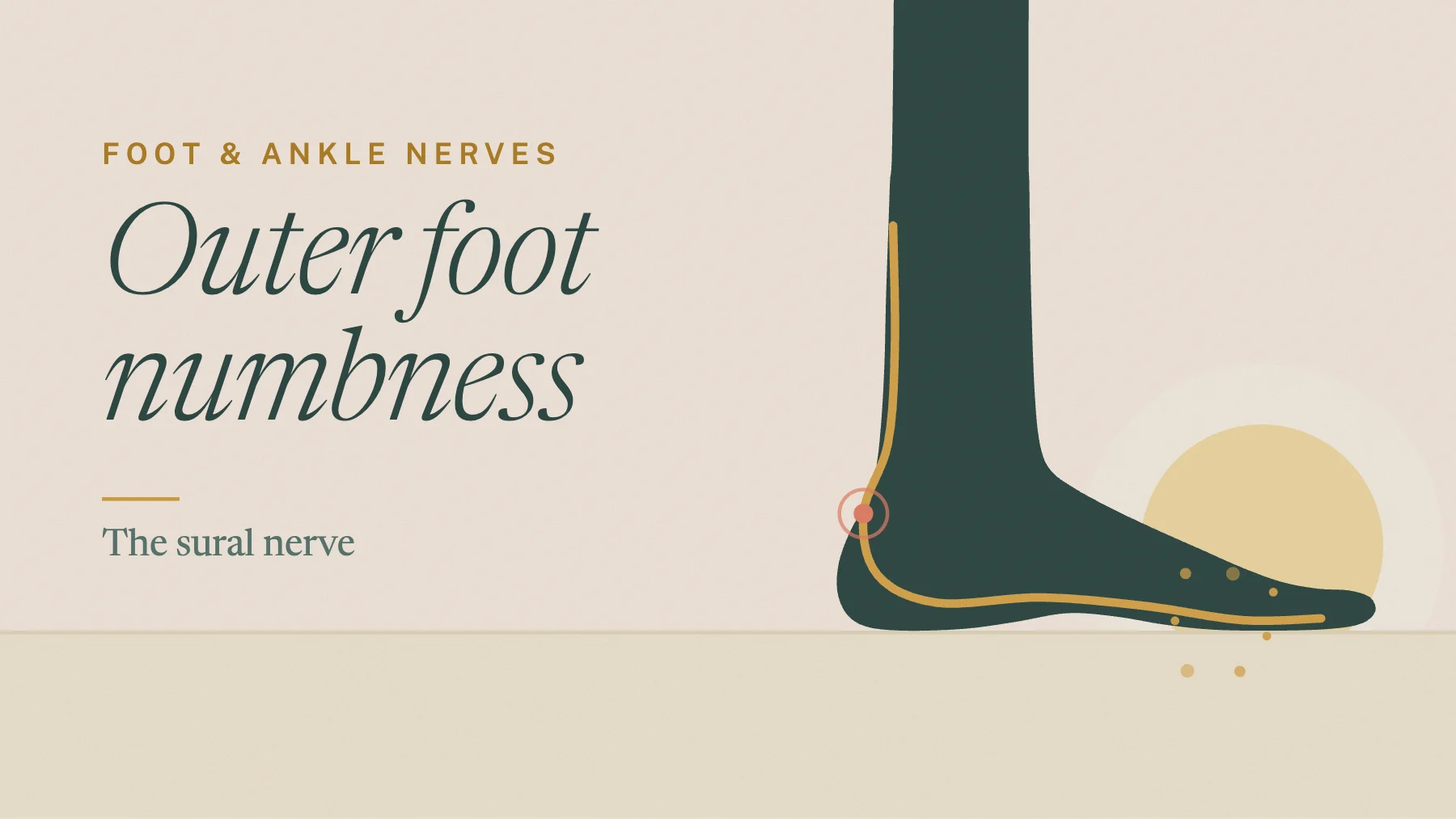
Numbness along the outer edge of the foot, sometimes reaching the little toe, is easy to brush off. But when it follows an ankle fracture, an Achilles operation or another procedure near the ankle, it deserves a closer look. The nerve responsible is a thin sensory nerve called the sural nerve.
Where the sural nerve runs
The sural nerve runs behind the outer ankle bone (the lateral malleolus) and along the outer border of the foot.[1] It is one of the nerves covered in reviews of tunnel syndromes of the foot and ankle, which describe burning pain, tingling and, depending on the nerve, weakness as typical features.[5]
What can irritate it
- Scar tissue. The nerve can be irritated by scar tissue after ankle fractures or Achilles tendon surgery.[1]
- Pressure from footwear over the outer ankle.[1]
- Surgery near the ankle. In a review of nine people with injured sural nerves after surgery, the ankle was the site of injury in 89%. The surgeries involved went beyond Achilles repair. The most common problem found was a neuroma, followed by entrapment, bruising of the nerve, and complete transection.[2]
- Arthroscopy. In a study of 545 ankle arthroscopies, 24% of the nerve complications involved the sural nerve, and the rest mostly involved the superficial peroneal nerve at the front of the ankle.[6]
For Achilles repairs specifically, a meta-analysis of randomized trials found no difference in sural nerve injury between minimally invasive and open techniques.[7]
What it feels like
People with a sural nerve injury after surgery most often describe pain, numbness and tingling, with tenderness and loss of sensation along the outer foot.[2] Some have a spot at the scar or behind the ankle that sends a zing into the foot when it is tapped.
Is it the nerve, or is it the back?
The outer edge of the foot and the little toe are also supplied from the lower back, through the nerve roots that form the sciatic nerve. A pinched nerve root in the lower back can give similar numbness, usually with pain from the back or buttock.[3,4] If the numbness began after an ankle operation and the back is quiet, the sural nerve becomes more likely. If it came with back pain, the back needs to be considered. See sciatica or a foot nerve problem?
How it is evaluated
A careful examination maps the area of numbness, taps along the nerve and checks the scar. Ultrasound or MRI can show a neuroma, scar tissue or another structure pressing on the nerve, and the sural nerve is among the nerves described in imaging reviews of lower limb entrapment.[8,9] One thing the research shows clearly is delay. In the nine-patient review, the average time between the operation and completion of imaging for the nerve was about 80 weeks.[2] That is a reason to ask early if you notice nerve-type symptoms after surgery.
What helps
Treatment starts with removing pressure, changing footwear, protecting the area and, where appropriate, therapy and medicines for nerve pain coordinated with your other clinicians. Non-surgical treatments are often effective for foot and ankle tunnel syndromes, and surgical decompression is reserved for cases that don’t respond.[5] Painful neuromas can be treated surgically in selected cases. Results vary: in the nine-patient review, four people had surgery on the sural nerve and none had complete resolution of symptoms, although the sample was very small.[2] See nerve pain after surgery or injury and non-surgical treatment.
When to see a specialist
Consider an evaluation if numbness, burning or tingling along the outer foot lasts more than a few weeks, is getting worse, or began after an injury or operation.

About the author
Efe Ozturk, DPM
Foot and Ankle Surgeon. Dr. Ozturk is double board certified, as a Diplomate of the American Board of Podiatric Medicine (DABPM) and a Fellow of the Academy of Physicians in Wound Healing (FAPWH), and is a Fellow of the American Society of Podiatric Surgeons (FASPS) and the American Society of Podiatric Medicine (FASPM). He leads the Lower Extremity Nerve Institute, a specialty practice of Ozturk Foot & Ankle, and sees patients in Lyndhurst, Paramus and Millburn, New Jersey.
References
- 1.Pomeroy G, Wilton J, Anthony S. Entrapment neuropathy about the foot and ankle: an update. J Am Acad Orthop Surg. 2015;23(1):58-66. PubMed 25538131 (external site)
- 2.Finkelstein ER, Stewart SJ, Del Toro C, et al. Procedures Leading to Iatrogenic Injury of the Sural Nerve. Plast Reconstr Surg Glob Open. 2026;14(5):e7775. PubMed 42199244 (external site)
- 3.Jensen RK, Kongsted A, Kjaer P, Koes B. Diagnosis and treatment of sciatica. BMJ. 2019;367:l6273. PubMed 31744805 (external site)
- 4.Ropper AH, Zafonte RD. Sciatica. N Engl J Med. 2015;372(13):1240-8. PubMed 25806916 (external site)
- 5.Bojovic M, Dimitrijevic S, Olory BCR, et al. Overview of nerve entrapment syndromes in the foot and ankle. Int Orthop. 2025;49(4):853-862. PubMed 40042611 (external site)
- 6.Roche D, Lopes R. Postoperative sensory nerve complications following ankle arthroscopy: incidence, risk factors, and clinical course in 545 consecutive procedures. Foot Ankle Int. 2026;47(9):1137-1147. PubMed 42500939 (external site)
- 7.Grassi A, Amendola A, Samuelsson K, et al. Minimally Invasive Versus Open Repair for Acute Achilles Tendon Rupture: Meta-Analysis Showing Reduced Complications, with Similar Outcomes, After Minimally Invasive Surgery. J Bone Joint Surg Am. 2018;100(22):1969-1981. PubMed 30480601 (external site)
- 8.Kumar S, Mangi MD, Zadow S, Lim W. Nerve entrapment syndromes of the lower limb: a pictorial review. Insights Imaging. 2023;14(1):166. PubMed 37782348 (external site)
- 9.Beltran LS, Bencardino J, Ghazikhanian V, Beltran J. Entrapment neuropathies III: lower limb. Semin Musculoskelet Radiol. 2010;14(5):501-11. PubMed 21072728 (external site)
This article is general health information and isn’t a substitute for advice from a clinician who knows your history. Read our medical disclaimer and how we review content.
More from the blog
Foot & ankle nerves
Heel pain: plantar fasciitis or a pinched nerve?
Stretching and new shoes haven’t worked? A small nerve under the heel can cause pain that looks just like plantar fasciitis. Here are the clues.
Foot & ankle nerves
Can a pinched nerve in the foot heal on its own?
Sometimes, when the pressure comes off. What affects recovery of a pinched foot nerve, what you can do meanwhile, and when to stop waiting.
Foot & ankle nerves
Morton’s neuroma injections: what to expect
What a steroid injection can and can’t do for Morton’s neuroma, how long relief lasts, and when surgery comes up.