Sciatica or a foot nerve problem? Five clues to tell them apart
Where it starts, what triggers it, and what a tap on the nerve does: five clues to whether your foot symptoms come from the back or the foot.

By Efe Ozturk, DPM · 5 min read
Medically reviewed by Efe Ozturk, DPM · Last reviewed
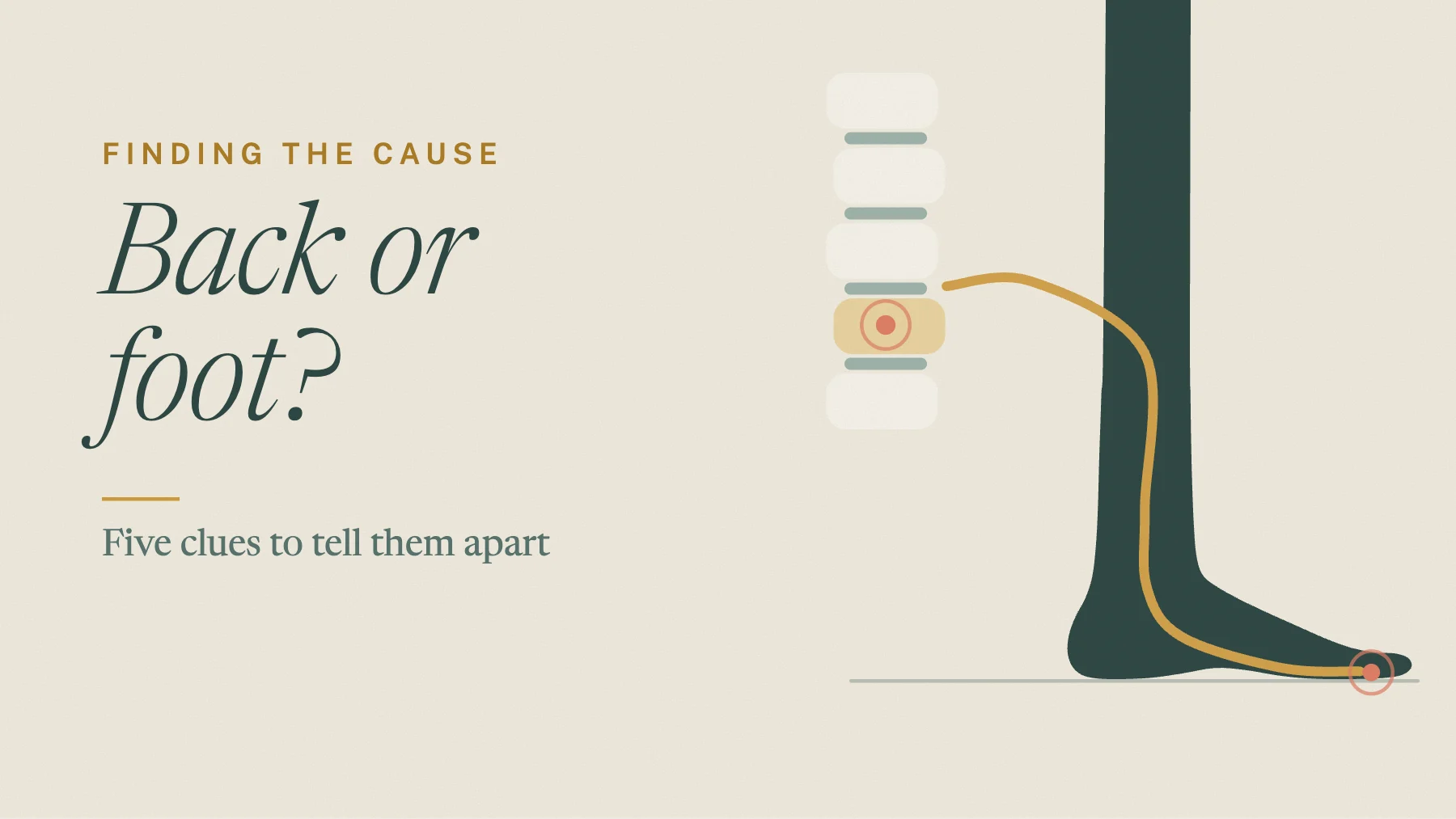
Foot pain, numbness or tingling doesn’t always start in the foot. It can start in the back, the buttock, the knee or the ankle, and your brain will read the signal as coming from the foot whichever spot is irritated. That is why a pinched nerve in the back and a pinched nerve in the foot are so easily confused.
One pathway, many places for trouble
The nerve roots in the lower spine join to form the sciatic nerve, which runs down the back of the thigh and divides near the knee into the tibial nerve and the peroneal nerve. These continue down the leg and split into the small nerves of the foot.[1] A squeeze at any point can send symptoms into the foot.
Sciatica is pain that follows the path of the sciatic nerve or one of its roots, usually from the buttock down the back or side of the leg, sometimes into the foot. It is most often caused by a pinched nerve root in the lower back.[2,3] Foot nerve entrapment happens when a nerve is compressed further down, for example in the tarsal tunnel at the inner ankle or between the toes in Morton’s neuroma.
Five clues that point to the back or to the foot
These are tendencies, not rules, and they overlap.
- Where it starts. Symptoms that begin in the back or buttock and travel down the leg suggest the back. Symptoms that begin in the foot or around the ankle suggest the foot.
- What brings it on. Sitting, bending, coughing or sneezing tend to stir up back-related pain. Standing, walking or particular shoes, especially if it eases when you take your shoes off, fit a foot problem better.
- Tapping along the nerve. With a foot nerve problem there is often a spot where tapping sends tingling into the foot. With a problem in the back there is usually no single tender spot in the foot.
- Back or buttock pain. It is often, though not always, present with sciatica, and is usually absent with a foot entrapment.
- Weakness. With a back problem, weakness can affect the muscles that lift the foot or push off. With a foot nerve problem, weakness is less common and usually limited to small muscles in the foot.
A sixth possibility is worth knowing about. Symptoms in both feet, starting at the toes, point to peripheral neuropathy, a body-wide nerve problem that typically begins at the tips of the longest nerves and creeps upward. It can also happen together with either of the others.[6]
When both are involved
A nerve can be squeezed in two places at once. This is called double crush syndrome. It is a debated idea, but it may help explain why some people don’t get better after treatment at only one site.[4]
A recent case series looked at 14 people with a pinched L5 nerve root in the lower back and a compressed peroneal nerve at the knee. Seven were referred for the back problem and were also found to have a compressed peroneal nerve. The other seven still had symptoms after their back had been treated, which suggested the peroneal nerve was involved as well. After the peroneal nerve was released at the knee, 93% had a successful result, though the series was small and from a single center. The authors concluded that this combination occurs more often than expected and can be missed.[5]
The practical lesson is simple. If treatment for your back hasn’t fixed your foot symptoms, or treatment for your foot hasn’t helped, the whole pathway deserves a fresh look.
How doctors find the source
- Your story: where symptoms start, what provokes and relieves them, and any back or leg pain, injuries or surgery.
- An examination of the whole leg: the back, hip and knee, movements that stretch the sciatic nerve, strength, reflexes, sensation, tapping along the nerves, foot alignment and circulation.
- Nerve studies and EMG, which can help show whether trouble is at the nerve root, along the nerve in the leg, or in the foot.[7,8] A normal result does not rule out a nerve problem. These tests are done by another specialist. See what to expect from an EMG.
- Imaging such as an MRI of the lower back, or an ultrasound or MRI of the foot. Scans need to be read alongside the examination. A systematic review of 3,110 people with no symptoms found disc degeneration on imaging in 37% of 20-year-olds and 96% of 80-year-olds, so a change on a scan does not always explain symptoms.[9]
What happens next
If the evidence points to the back, you can be pointed to the right care, such as your primary care physician, a spine specialist or a physical therapist. If it points to the foot, treatment usually starts with non-surgical care. If both are involved, the plan should make sure treating one doesn’t leave the other unaddressed. For more detail, see back or foot? finding the source of nerve pain and sciatica.
When to see a specialist
Consider an evaluation if you have had foot pain, numbness or tingling for more than a few weeks and can’t tell whether your back or your foot is responsible, or if you have had treatment for your back or foot and still have symptoms.

About the author
Efe Ozturk, DPM
Foot and Ankle Surgeon. Dr. Ozturk is double board certified, as a Diplomate of the American Board of Podiatric Medicine (DABPM) and a Fellow of the Academy of Physicians in Wound Healing (FAPWH), and is a Fellow of the American Society of Podiatric Surgeons (FASPS) and the American Society of Podiatric Medicine (FASPM). He leads the Lower Extremity Nerve Institute, a specialty practice of Ozturk Foot & Ankle, and sees patients in Lyndhurst, Paramus and Millburn, New Jersey.
References
- 1.Lezak B, Massel DH, Varacallo MA. Peroneal Nerve Injury. In: StatPearls. StatPearls Publishing; updated 2024. PubMed 31751049 (external site)
- 2.Jensen RK, Kongsted A, Kjaer P, Koes B. Diagnosis and treatment of sciatica. BMJ. 2019;367:l6273. PubMed 31744805 (external site)
- 3.Ropper AH, Zafonte RD. Sciatica. N Engl J Med. 2015;372(13):1240-8. PubMed 25806916 (external site)
- 4.Kane PM, Daniels AH, Akelman E. Double Crush Syndrome. J Am Acad Orthop Surg. 2015;23(9):558-62. PubMed 26306807 (external site)
- 5.den Boogert HF, Schuuring J, de Ruiter GCW. Double Crush Syndrome of the L5 Nerve Root and Common Peroneal Nerve at the Fibular Head: A Case Series and Review of the Literature. J Clin Med. 2025;14(14). PubMed 40725716 (external site)
- 6.Mauermann ML, Staff NP. Peripheral Neuropathy: A Review. JAMA. 2026;335(3):255-266. PubMed 41247746 (external site)
- 7.Patel AT, Gaines K, Malamut R, Park TA, Toro DR, Holland N, et al. Usefulness of electrodiagnostic techniques in the evaluation of suspected tarsal tunnel syndrome: an evidence-based review. Muscle Nerve. 2005;32(2):236-40. PubMed 16003732 (external site)
- 8.Carolus AE, Becker M, Cuny J, Smektala R, Schmieder K, Brenke C. The Interdisciplinary Management of Foot Drop. Dtsch Arztebl Int. 2019;116(20):347-354. PubMed 31288916 (external site)
- 9.Brinjikji W, Luetmer PH, Comstock B, et al. Systematic literature review of imaging features of spinal degeneration in asymptomatic populations. AJNR Am J Neuroradiol. 2015;36(4):811-6. PubMed 25430861 (external site)
This article is general health information and isn’t a substitute for advice from a clinician who knows your history. Read our medical disclaimer and how we review content.
More from the blog
Finding the cause
Normal EMG but still nerve pain? Why that happens
Why a normal EMG doesn’t rule out a nerve problem, and what to do when the test is normal but the pain isn’t.
Finding the cause
Ultrasound or MRI for foot nerve pain: which is better?
What ultrasound and MRI can show about a nerve problem in the foot, how they compare, and why a scan isn’t the whole answer.
Finding the cause
When to get a second opinion for foot nerve pain
When a second opinion makes sense, why nerve pain can persist after surgery, and what a fresh evaluation should include.