When to get a second opinion for foot nerve pain
When a second opinion makes sense, why nerve pain can persist after surgery, and what a fresh evaluation should include.

By Efe Ozturk, DPM · 4 min read
Medically reviewed by Efe Ozturk, DPM · Last reviewed
Most people never need a second opinion for a foot nerve problem. But some do, and they are often the ones who have been told “there’s nothing more we can do” or “it’s all in the normal range” while still hurting. Here is when a second look makes sense, and what it should cover.
Reasons to consider one
- Symptoms that haven’t improved several months after nerve surgery, or that came back after a period of improvement.
- Pain, burning or numbness after any operation or injury that hasn’t settled. See nerve pain after ankle surgery.
- An uncertain diagnosis. You have been treated for one problem, such as plantar fasciitis or a back problem, but the symptoms suggest a nerve, or the other way around.
- Treatment at one site hasn’t helped. Dissatisfaction after treatment at one site may be due to persistent pathology at another site along the same nerve.[3]
- Tests were normal but symptoms are real. Our guide to normal EMG but still nerve pain explains why that happens.
Why nerve symptoms can persist or return
A second opinion often starts by asking why. Some known reasons:
- The original diagnosis was incomplete or incorrect. After Morton’s neuroma surgery, symptoms may recur because of an incorrect diagnosis, inadequate resection, or pressure on a nerve stump neuroma.[1] Among primary neurectomies, 50% to 85% of patients obtain relief, and the relief rate after reoperation is similar.[1]
- The release was incomplete. In a series of eight revisions for failed tarsal tunnel release, insufficient release, especially further down the foot, was found in every patient.[2]
- A painful nerve end. After a nerve is cut, the end can form a new, sensitive neuroma, especially if it sits where it is pressed on when you walk.[1]
- A second pinch point or a body-wide neuropathy. A neuropathy can coexist with a compressive neuropathy and contribute to suboptimal results after decompression.[3] In a series of 14 people with a pinched L5 nerve root and a compressed peroneal nerve, seven still had symptoms after their back had been treated, and releasing the peroneal nerve gave a successful result in 93% of the group, although the series was small.[6]
What a good second opinion includes
- Your full story, including the original problem, the operation and how symptoms have changed.
- Records. Operative reports, imaging and previous test results. Ask your previous surgeon’s office to send them, or bring your own copies.
- A careful examination, mapping numbness and sensitivity, tapping along nerves and around scars, and checking for other causes such as neuropathy, circulation problems or the lower back.
- Tests that would change the plan, such as imaging or nerve studies, arranged with other specialists.
- An honest discussion of options, including non-surgical care.
What the options can be
- Non-surgical care. Footwear and padding changes, desensitization therapy, and medicine for nerve pain managed with your other clinicians. See pinched nerve in the foot: what to try before surgery.
- Revision surgery, when appropriate. For a recurrent Morton’s neuroma, revision often means removing the nerve further back and relocating the cut end into muscle or bone. In a long-term study of revision through a dorsal incision, 17 of 23 patients scored as excellent.[5,1] For a failed tarsal tunnel release, revision typically means re-releasing the tibial nerve and each of its branches in its own tunnel. In a series of 44 patients, 54% had excellent and 24% good results, and coexisting lumbosacral disc disease or neuropathy predicted poorer results.[4]
- For painful neuromas after several operations, options include removing the neuroma and relocating the nerve end, reconstructing the nerve, or giving it a target to grow into.[7] See revision nerve surgery and nerve repair and reconstruction.
Realistic expectations
Revision surgery is more complex than a first operation, and the published evidence consists mainly of small case series. The goal is a meaningful improvement in pain and function; complete relief is not always possible, and it is reasonable to take time to decide.
When to see a specialist
Consider an evaluation if nerve pain, burning or numbness hasn’t improved several months after nerve surgery, or if it returns after a period of improvement.
About the author
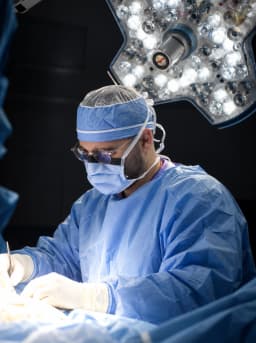
Efe Ozturk, DPM
Foot and Ankle Surgeon. Dr. Ozturk is double board certified, as a Diplomate of the American Board of Podiatric Medicine (DABPM) and a Fellow of the Academy of Physicians in Wound Healing (FAPWH), and is a Fellow of the American Society of Podiatric Surgeons (FASPS) and the American Society of Podiatric Medicine (FASPM). He leads the Lower Extremity Nerve Institute, a specialty practice of Ozturk Foot & Ankle, and sees patients in Lyndhurst, Paramus and Millburn, New Jersey.
References
- 1.Richardson DR, Dean EM. The recurrent Morton neuroma: what now? Foot Ankle Clin. 2014;19(3):437-449. PubMed 25129354 (external site)
- 2.Yalcinkaya M, Ozer UE, Yalcin MB, Bagatur AE. Neurolysis for failed tarsal tunnel surgery. J Foot Ankle Surg. 2014;53(6):794-798. PubMed 25128912 (external site)
- 3.Kane PM, Daniels AH, Akelman E. Double Crush Syndrome. J Am Acad Orthop Surg. 2015;23(9):558-62. PubMed 26306807 (external site)
- 4.Barker AR, Rosson GD, Dellon AL. Outcome of neurolysis for failed tarsal tunnel surgery. J Reconstr Microsurg. 2008;24(2):111-118. PubMed 18473284 (external site)
- 5.Ettehadi H, Saragas NP, Ferrao P. Patient reported outcomes following revision neurectomy through a dorsal approach for recurrent interdigital neuroma. Foot Ankle Surg. 2022;28(8):1210-1214. PubMed 35393246 (external site)
- 6.den Boogert HF, Schuuring J, de Ruiter GCW. Double Crush Syndrome of the L5 Nerve Root and Common Peroneal Nerve at the Fibular Head: A Case Series and Review of the Literature. J Clin Med. 2025;14(14). PubMed 40725716 (external site)
- 7.Eberlin KR, Ducic I. Surgical algorithm for neuroma management: a changing treatment paradigm. Plast Reconstr Surg Glob Open. 2018;6(10):e1952. PubMed 30534497 (external site)
This article is general health information and isn’t a substitute for advice from a clinician who knows your history. Read our medical disclaimer and how we review content.
More from the blog
Finding the cause
Normal EMG but still nerve pain? Why that happens
Why a normal EMG doesn’t rule out a nerve problem, and what to do when the test is normal but the pain isn’t.
Finding the cause
Ultrasound or MRI for foot nerve pain: which is better?
What ultrasound and MRI can show about a nerve problem in the foot, how they compare, and why a scan isn’t the whole answer.
Foot & ankle nerves
Heel pain: plantar fasciitis or a pinched nerve?
Stretching and new shoes haven’t worked? A small nerve under the heel can cause pain that looks just like plantar fasciitis. Here are the clues.