Can nerve damage in the foot be repaired? Your surgical options
Often, yes. How surgeons match the injury to the repair, how fast nerves regrow, and why the calendar matters more for muscle than for feeling.

By Dr. Efe Ozturk · 6 min read
Medically reviewed by Dr. Efe Ozturk · Last reviewed
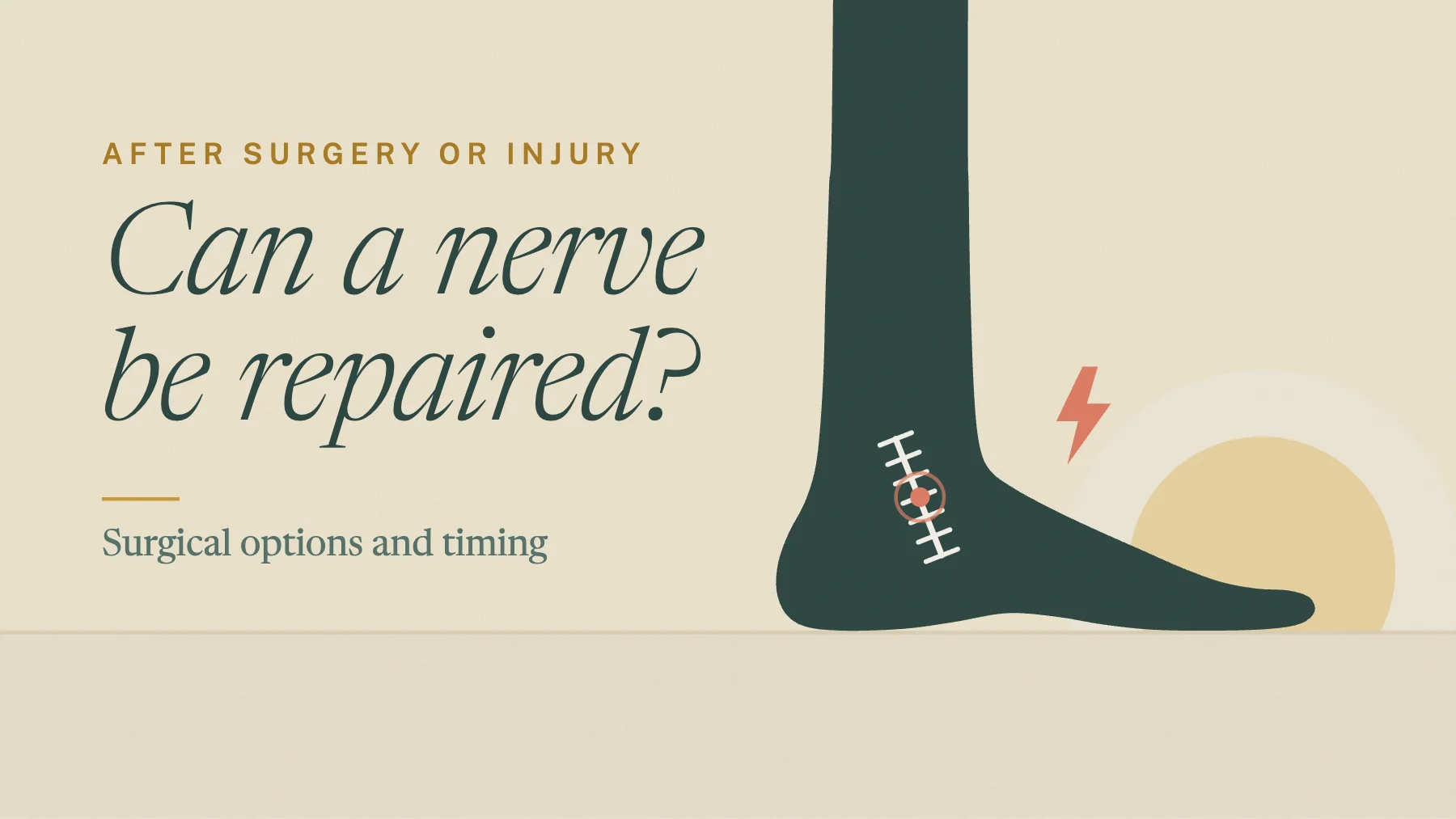
You stepped on glass, or you had an operation, and now part of your foot is numb, burning or weak. You want to know whether a surgeon can fix it. Often the answer is yes. Here is how the damage is matched to the repair, what results look like, and why the calendar matters.
Can nerve damage in the foot be repaired?
Nerve injuries run from mild to severe. In milder injuries the nerve’s outer structure holds together, the outlook is favorable, and surgery is often not needed. In the most severe injuries the inner structure is destroyed or the nerve is cut through. The outlook is then poor without help, and the options are repair, a graft or a transfer.[1]
One point needs saying early. This article is about a nerve hurt at a specific place. Body-wide nerve damage from diabetes or other causes is a different problem with different treatment. See peripheral neuropathy.
Which surgery repairs nerve damage in the foot?
Dr. Efe Ozturk, a double board certified Foot and Ankle Surgeon and podiatrist, performs each of the operations below for appropriate patients.
- Direct repair. The two nerve ends are sewn together under magnification. Fresh cuts around the foot and ankle should be repaired when the wound is first explored, which may also lower the risk of a painful neuroma.[2] In a review of 677 tibial nerve injuries, direct repair had the most good outcomes.[6] The tibial nerve serves the sole of the foot. See nerve repair and reconstruction.
- Nerve graft. A graft bridges a gap when the ends can’t meet without tension. It can be a piece of your own nerve, which leaves a numb patch where it was taken, or processed donor nerve. Across 1,559 repairs, not limited to the foot, the two gave similar meaningful recovery. In short sensory gaps, rates were 81.6% and 87.1%, compared with 62.2% for hollow tubes.[3]
- Nerve transfer. A working nerve branch is redirected to take over from a damaged one, close to the muscle.[7] It is used to restore foot lift after a peroneal nerve injury. Good strength returned in 58% of people when several branches were used and 43% with one.[4] See nerve transfer.
- Neuroma surgery. A neuroma is a painful knot at an injured nerve end. The surgeon removes it, then buries the nerve end or gives it a target.[5] Targeted muscle reinnervation (TMR) joins the nerve to a nearby motor nerve. A regenerative peripheral nerve interface (RPNI) wraps the end in a small muscle graft. In a pooled analysis of 1,150 neuromas, not limited to the foot, good results came in 70% overall and 82% with TMR.[8] See neuroma surgery.
- Decompression. Tight tissue pressing on a nerve is released. In a pooled study of 368 people with weak foot lift from a peroneal nerve problem at the knee, 53.9% reached full strength.[9]
- Revision surgery and joint denervation. Revision surgery revisits a nerve when a first operation didn’t settle the problem. Joint denervation interrupts small nerves that carry pain from a joint. It is rarely reported, but it may help selected people with nerve-related pain around the ankle.[10]
The right choice also depends on the nerve. Most long-standing nerve injuries around the foot and ankle are managed by removing the painful neuroma and burying the nerve end. The tibial nerve and its major branches are the exception.[2] The tibial nerve also tends to recover better than the peroneal nerve. In graft repairs at the knee or leg, one large series reported good outcomes in 94% of tibial nerves and 40% of peroneal nerves.[11]
How fast do nerves regrow after repair?
Nerves regrow about 1 mm a day, and only forward from the injury.[1] That is a little over an inch a month. As a rough guide, a nerve regrowing from the ankle to the toes, about 8 inches, needs six to seven months. From the knee to the ankle, about 16 inches, it needs more than a year.
Tingling that moves forward along the nerve over time can be a good sign. Tingling that stays in one spot is less hopeful.[1]
Why does timing matter for nerve repair?
A muscle cut off from its nerve can’t wait forever. A 2021 review of nerve surgery timing gives these guides:[1]
- Nerves that run muscles. Repair within 24 hours when possible, or within 14 days of being seen if the injury is under six months old. After six months, grafts, nerve transfers or tendon transfers may be needed.
- The one-year mark. After a complete cut, regrowing fibers should reach the muscle within about a year. Permanent damage to the nerve-muscle connection has been seen as early as 12 months.
- Nerves that carry feeling. Repair within 14 days when possible, partly to prevent a neuroma. Feeling can still return years later, though less predictably.
- Lasting pain. If pain continues three to six months after a nerve injury, the review recommends planning surgical treatment.
The numbers are sobering. In a review of more than 200 arm nerve injuries, good or excellent muscle recovery fell from 85.7% with immediate repair to 71.9% at one to three months and 25.0% after six months.[1] Those were arm nerves, but leg nerves show the same pattern. Tibial nerve injuries did better with surgery before seven months, and peroneal nerve injuries did better with a shorter wait.[6,12]
Waiting is sometimes right. Open wounds with nerve injury should be explored within about a week. Closed injuries, such as a stretch or crush, are usually watched for three to six months.[13] If recovery stalls during that time, a recent review advises exploring early.[14] Nerve studies arranged with another specialist can help track this.
What are the limits of nerve repair?
Nerve repair improves function and pain, but normal feeling or full strength may not return. Lower limb neuroma surgery brought lasting improvement in 59% of people, while 19% still had severe pain. Smoking and low mood were linked to worse results.[15] TMR and RPNI research comes mostly from people with amputations, and only one of 17 studies in a recent review was a randomized trial.[16] Risks include infection, slow wound healing, a new neuroma and more surgery. Our Center for Lower Extremity Surgery explains how smoking and diabetes affect healing (external site).
Common questions
Can nerve damage in the foot heal on its own?
Mild injuries often can, given time. A nerve that has been cut through generally can’t. See can a pinched nerve in the foot heal on its own?
What is the right treatment for nerve damage in the foot?
It depends on the cause, the nerve and how long ago it happened. Start with an exam that pins down which nerve is hurt and how badly.
How do you help nerve damage in the foot heal?
Remove any pressure on the nerve. Protect numb skin from heat, cuts and tight shoes. Keep your blood sugar controlled and avoid smoking. Don’t wait months if the foot is weak.
When to see a specialist
Book an evaluation if numbness, burning or weakness has not improved a few days after a cut, injury or operation. We see patients in Lyndhurst, Paramus and Millburn.
About the author
Dr. Efe Ozturk
Foot and Ankle Surgeon. Dr. Ozturk is double board certified, as a Diplomate of the American Board of Podiatric Medicine (DABPM) and a Fellow of the Academy of Physicians in Wound Healing (FAPWH), and is a Fellow of the American Society of Podiatric Surgeons (FASPS) and the American Society of Podiatric Medicine (FASPM). He leads the Lower Extremity Nerve Institute, a specialty practice of Ozturk Foot & Ankle, and sees patients in Lyndhurst, Paramus and Millburn, New Jersey.
References
- 1.MacKay BJ, Cox CT, Valerio IL, et al. Evidence-based approach to timing of nerve surgery: a review. Ann Plast Surg. 2021;87(3):e1-e21. PubMed 33833177 (external site)
- 2.Thordarson DB, Shean CJ. Nerve and tendon lacerations about the foot and ankle. J Am Acad Orthop Surg. 2005;13(3):186-96. PubMed 15938607 (external site)
- 3.Lans J, Eberlin KR, Evans PJ, Mercer D, Greenberg JA, Styron JF. A systematic review and meta-analysis of nerve gap repair: comparative effectiveness of allografts, autografts, and conduits. Plast Reconstr Surg. 2023;151(5):814e-827e. PubMed 36728885 (external site)
- 4.Duraku LS, Buijnsters ZA, Power DM, George S, Walbeehm ET, de Jong T. Motor and sensory nerve transfers in the lower extremity: Systematic review of current reconstructive possibilities. J Plast Reconstr Aesthet Surg. 2023;84:323-333. PubMed 37390541 (external site)
- 5.Eberlin KR, Ducic I. Surgical algorithm for neuroma management: a changing treatment paradigm. Plast Reconstr Surg Glob Open. 2018;6(10):e1952. PubMed 30534497 (external site)
- 6.Garg SP, Hassan AM, Patel AA, et al. Outcomes of Tibial Nerve Repair and Transfer: A Structured Evidence-Based Systematic Review and Meta-Analysis. J Foot Ankle Surg. 2021;60(6):1280-1289. PubMed 34366221 (external site)
- 7.Gordon T, Eva P, Borschel GH. Delayed peripheral nerve repair: methods, including surgical 'cross-bridging' to promote nerve regeneration. Neural Regen Res. 2015;10(10):1540-4. PubMed 26692833 (external site)
- 8.Langeveld M, Hundepool CA, Duraku LS, Power DM, Rajaratnam V, Zuidam JM. Surgical Treatment of Peripheral Nerve Neuromas: A Systematic Review and Meta-Analysis. Plast Reconstr Surg. 2022;150(4):823e-834e. PubMed 35895004 (external site)
- 9.Chow AL, Levidy MF, Luthringer M, Vasoya D, Ignatiuk A. Clinical Outcomes After Neurolysis for the Treatment of Peroneal Nerve Palsy: A Systematic Review and Meta-Analysis. Ann Plast Surg. 2021;87(3):316-323. PubMed 34397520 (external site)
- 10.Gohritz A, Dellon AL, Kalbermatten D, Fulco I, Tremp M, Schaefer DJ. Joint denervation and neuroma surgery as joint-preserving therapy for ankle pain. Foot Ankle Clin. 2013;18(3):571-89. PubMed 24008220 (external site)
- 11.Murovic JA. Lower-extremity peripheral nerve injuries: a Louisiana State University Health Sciences Center literature review with comparison of the operative outcomes of 806 Louisiana State University Health Sciences Center sciatic, common peroneal, and tibial nerve lesions. Neurosurgery. 2009;65(4 Suppl):A18-23. PubMed 19927065 (external site)
- 12.Mackay MJ, Ayres JM, Harmon IP, Tarakemeh A, Brubacher J, Vopat BG. Traumatic Peroneal Nerve Injuries: A Systematic Review. JBJS Rev. 2022;10(1). PubMed 35020680 (external site)
- 13.Robla-Costales J, Rodríguez-Aceves C, Martínez-Benia F, Socolovsky M. State of the Art and Advances in Peripheral Nerve Surgery. Adv Tech Stand Neurosurg. 2022;45:245-283. PubMed 35976453 (external site)
- 14.Sakthiyendran NA, Morris K, Cushman CJ, Hernandez EJ, Idicula A, MacKay BJ. Surgical Outcomes in Non-Transected and Partially Transected Peripheral Nerve Injuries. Brain Sci. 2025;15(11). PubMed 41300211 (external site)
- 15.Anantavorasakul N, Lans J, Macken AA, Sood RF, Chen NC, Eberlin KR. Surgery for lower extremity symptomatic neuroma: Long-term outcomes. J Plast Reconstr Aesthet Surg. 2020;73(8):1456-1464. PubMed 32513643 (external site)
- 16.Mauch JT, Kao DS, Friedly JL, Liu Y. Targeted muscle reinnervation and regenerative peripheral nerve interfaces for pain prophylaxis and treatment: A systematic review. PM R. 2023;15(11):1457-1465. PubMed 36965013 (external site)
This article is general health information and isn’t a substitute for advice from a clinician who knows your history. Read our medical disclaimer and how we review content.
More from the blog
After surgery or injury
Numbness or burning after an ankle sprain: when the injury stretched a nerve too
An inversion sprain can stretch the peroneal and sural nerves along with the ligaments. Stretched nerves can recover within weeks; when numbness or burning lasts, a nerve release, neuroma surgery or ligament repair can help.
After surgery or injury
Nerve pain after bunion or hammertoe surgery: what’s normal and what fixes it
A small nerve next to the big toe or along a lesser toe can be stretched, scarred or cut during forefoot surgery. Most numbness fades; a painful neuroma that doesn’t can be treated with nerve surgery.
After surgery or injury
Nerve pain after ankle surgery: what’s normal and what isn’t
Numbness near a scar is common; burning, electric pain is a reason to ask. What’s expected, what the research shows and what can help.