Nerve pain at the front of the knee after knee replacement
When the implant looks fine but the front of the knee burns, a small nerve may be the cause. The clues and the options.

By Efe Ozturk, DPM · 4 min read
Medically reviewed by Efe Ozturk, DPM · Last reviewed
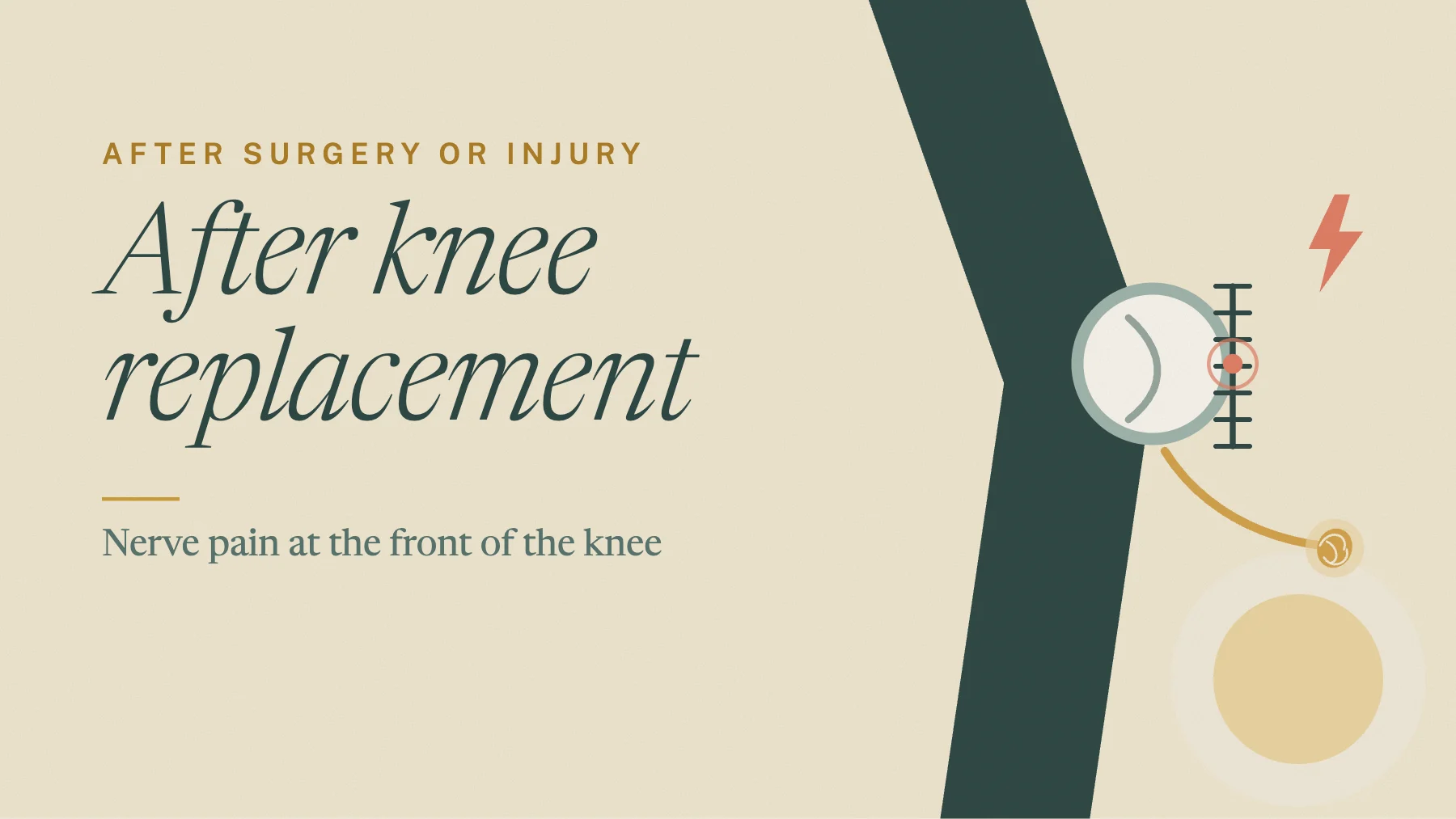
Your new knee is stable, the X-rays look good, and the surgeon says the implant is where it should be. Yet the front of your knee still burns, or a patch of skin beside the scar feels strangely numb or too sensitive to touch. If that sounds like you, the answer may not be in the metal and plastic at all. It may be a nerve.
Why “the implant looks fine” isn’t the end of the story
Most people do well after knee replacement, but up to about one in five continue to have chronic pain afterward.[1] Surgeons rule out the mechanical explanations first: a loose component, poor alignment, instability or infection. When none of these is found, attention turns to other sources, and a nerve is high on that list.[4]
Your own pain history plays a part too. When researchers pooled 15 studies covering 2,385 people, those who already had nerve-type pain before their operation were nearly three times as likely (risk ratio 2.75) to have lasting pain afterward.[6] That is useful to mention to your surgical team before an operation, not just after.
The nerve most often involved
A thin sensory branch of the saphenous nerve, called the infrapatellar branch, crosses the front of the knee. Researchers describe it as under-studied even though it can be a real source of chronic knee pain. Injury to it is often a side effect of surgery, whether a knee replacement, a ligament reconstruction or another knee operation, and entrapment, neuromas and benign nerve-sheath tumors can cause pain from the same nerve.[3] A neuroma there is thought to be a commonly missed explanation for pain that lingers at the front of the knee after replacement.[2]
What it tends to feel like
Patients describe things like a burning, electrical or shooting quality at the front or inner edge of the knee, a numb or oversensitive strip of skin near the incision, and one small spot that sends a zing along the nerve when it is tapped. Pain that stays beyond the usual recovery window is another flag. None of this proves a nerve is to blame, since stiffness and swelling have other causes and deserve their own work-up.
How the question gets answered
Your knee surgeon normally leads the first stage, clearing the implant. After that, two findings carry weight: a positive Tinel sign, meaning tingling when the nerve is tapped, and real relief after a numbing injection placed right beside the nerve.[4]
A study of 55 patients with suspected nerve pain after knee surgery shows how helpful that is. Thirty-seven of them responded to a diagnostic block. Ultrasound had shown a neuroma or a trapped nerve in almost every responder but in very few non-responders (97% versus 6%). A positive Tinel sign and a stable knee predicted a good outcome, and everyone who got complete relief from nerve treatment turned out to have one of those two nerve findings. Those who did not improve more often had an unstable joint, which is a cue to keep looking for other causes.[5] Blocks and imaging of this kind are arranged with another specialist.
The treatment ladder
Options typically start gently and climb:
- Conservative measures, such as skin desensitization, padding or a sleeve, nerve-pain medicines and injections around the nerve.
- Procedures that quiet the nerve’s signal. One systematic review of radiofrequency ablation of the genicular nerves for pain after knee surgery judged the evidence to be of low quality, while another review of nine studies reported pain gains lasting up to three months, with few complications.[7,8]
- Surgery on the nerve itself, either removing the neuroma or freeing a trapped nerve.[3]
For the surgical step, the numbers are encouraging but small. In one group of 15 patients whose pain had lasted more than six months, taking out the neuroma brought average pain scores from 8.6 down to 0.8 on a 10-point scale, with no complications at about eight months.[4] A second series of 13 patients reported an average improvement of 4.2 points.[2] Both were uncontrolled and short-term, so they cannot promise the same for you.
Questions worth bringing to your knee surgeon
- Have you ruled out a problem with the implant, including infection and instability?
- Is there a spot where tapping reproduces my burning or shooting pain?
- Would a diagnostic nerve block be reasonable, and who would perform it?
- If the nerve is the source, what are the options, and what does recovery involve?
The condition page on nerve pain after knee replacement goes deeper. For neuromas elsewhere in the leg, see painful neuroma and neuroma surgery options.
When to see a specialist
Think about a nerve evaluation if knee pain after a replacement is burning, electric or numb, or if it simply outlasts the recovery you were told to expect.
About the author
Efe Ozturk, DPM
Foot and Ankle Surgeon. Dr. Ozturk is double board certified, as a Diplomate of the American Board of Podiatric Medicine (DABPM) and a Fellow of the Academy of Physicians in Wound Healing (FAPWH), and is a Fellow of the American Society of Podiatric Surgeons (FASPS) and the American Society of Podiatric Medicine (FASPM). He leads the Lower Extremity Nerve Institute, a specialty practice of Ozturk Foot & Ankle, and sees patients in Lyndhurst, Paramus and Millburn, New Jersey.
References
- 1.Colovic D, Draschl A, Reinbacher P, Hecker A, Schittek G, Fischerauer SF, et al. Evaluation of Neuropathic Pain after Total Knee Arthroplasty: Do Yellow Flags Matter?. J Clin Med. 2023;12(24). PubMed 38137778 (external site)
- 2.Giannetti A, Valentino L, Giovanni Mazzoleni M, Tarantino A, Calvisi V. Painful total knee arthroplasty: Infrapatellar branch of the saphenous nerve selective denervation. A case series. Knee. 2022;39:197-202. PubMed 36209652 (external site)
- 3.Abd-Elsayed A, Henjum LJ, Shiferaw BT, Yassa PE, Fiala KJ. Infrapatellar Branch of the Saphenous Nerve: Therapeutic Approaches to Chronic Knee Pain. Curr Pain Headache Rep. 2024;28(4):279-294. PubMed 38294640 (external site)
- 4.Chalidis B, Kitridis D, Givissis P. Surgical treatment outcome of painful traumatic neuroma of the infrapatellar branch of the saphenous nerve during total knee arthroplasty. World J Orthop. 2021;12(12):1008-1015. PubMed 35036343 (external site)
- 5.Yang SR, Hirschmann MT, Schiffmann A, Kovacs BK, Gehweiler J, Amsler F, et al. Diagnostics of infrapatellar saphenous neuralgia-a reversible cause of chronic anteromedial pain following knee surgery. Eur Radiol. 2022;32(2):1342-1352. PubMed 34342695 (external site)
- 6.Gonzalez FF, Barone A, Palaniappan R, Russo R, Gasparini G, Metsavaht L, et al. Preoperative neuropathic-like pain and central sensitisation are risk factors for chronic pain after total knee arthroplasty: A systematic review and meta-analysis. Osteoarthr Cartil Open. 2025;7(4):100674. PubMed 40995335 (external site)
- 7.Kanjanapanang N, Madrid R, Lin P, Shilling M, Cooper A, Sen H, et al. Effectiveness of genicular nerve radiofrequency ablation in osteoarthritis and post-surgical knee pain: systematic review. Pain Med. 2026;27(2):189-208. PubMed 40855681 (external site)
- 8.Cheppalli N, Bhandarkar AW, Sambandham S, Oloyede SF. Safety and Efficacy of Genicular Nerve Radiofrequency Ablation for Management of Painful Total Knee Replacement: A Systematic Review. Cureus. 2021;13(11):e19489. PubMed 34912630 (external site)
This article is general health information and isn’t a substitute for advice from a clinician who knows your history. Read our medical disclaimer and how we review content.
More from the blog
After surgery or injury
Nerve pain after Achilles surgery: the sural nerve
How often the sural nerve is affected after Achilles repair, what it feels like, and what can be done.
After surgery or injury
Phantom pain or a neuroma after amputation: telling them apart
Phantom limb pain and a residual limb neuroma can look alike and can coexist. How they differ and what treatment offers.
After surgery or injury
Complex regional pain syndrome after foot surgery: early signs
Pain that grows instead of fading, with skin or temperature changes, can be CRPS. The early signs and what to do.