Nerve pain after Achilles surgery: the sural nerve
How often the sural nerve is affected after Achilles repair, what it feels like, and what can be done.

By Efe Ozturk, DPM · 4 min read
Medically reviewed by Efe Ozturk, DPM · Last reviewed
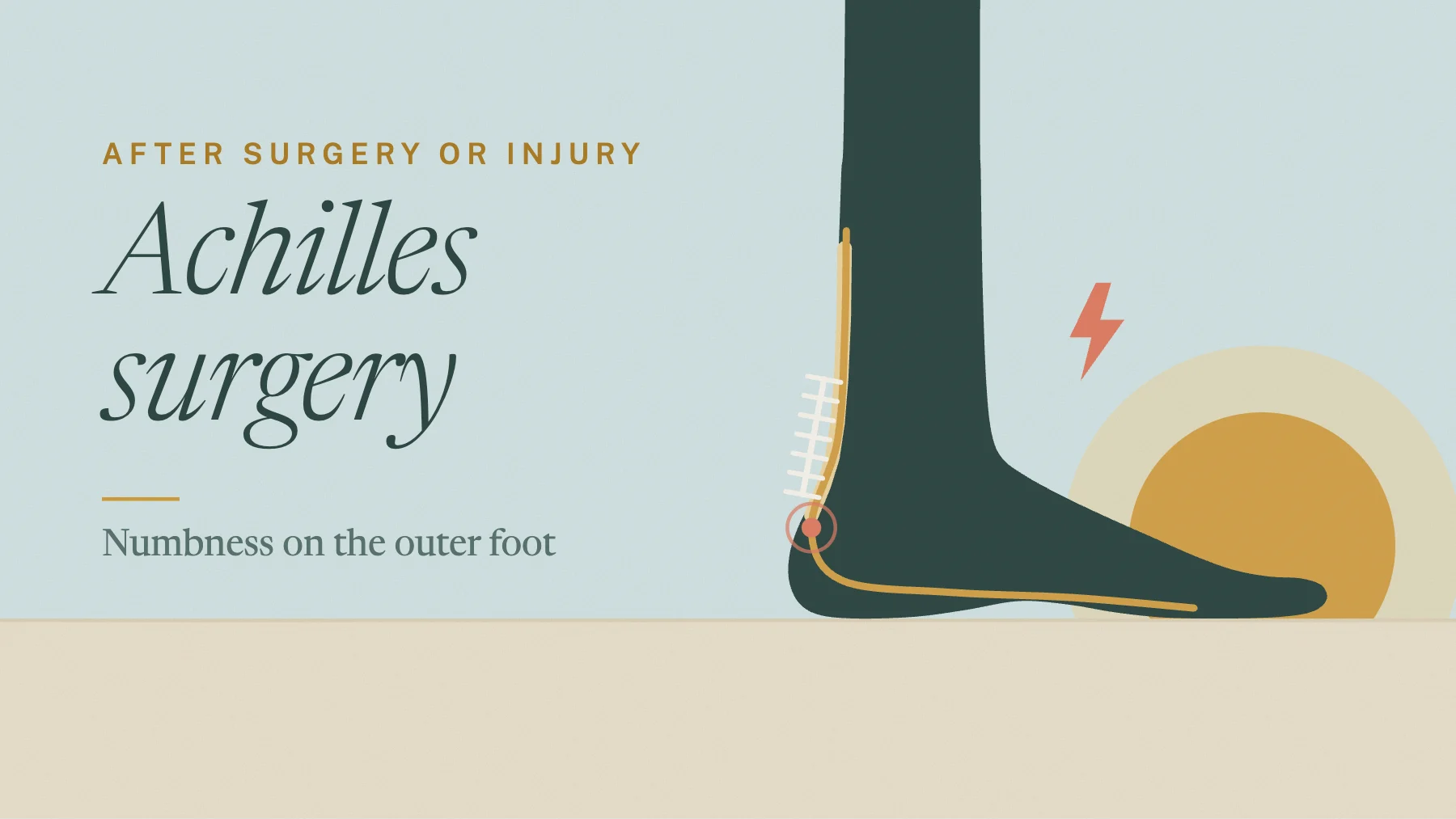
An Achilles repair is meant to get you walking and running again. So it can be unsettling to wake up to a strip of numbness, burning or “zinging” along the outside of your foot. This is a known possibility after surgery around the Achilles tendon, and there are things worth knowing about why it happens and what can be done.
Why the sural nerve is at risk
The sural nerve is a sensory nerve that runs behind the outer ankle bone and along the outer border of the foot.[2] Sural nerve injury is a reported risk during percutaneous repair of the Achilles tendon.[1] Scar tissue after ankle fractures or Achilles surgery can also irritate it.[2] For the anatomy and other causes, see numbness on the outside of the foot: the sural nerve.
How often does it happen?
The honest answer is that it depends on the technique and the study:
- In a systematic review of 253 acute Achilles repairs with a mini-open suture system, 1.2% (3 repairs) had a sural nerve injury.[3]
- In a comparison of percutaneous repairs at two hospitals, sural nerve-related complications occurred in 18% overall, and all of them were in the group where the nerve was not exposed during the repair. The authors concluded that injuries can be minimized by placing the incisions so that the nerve is exposed and avoided.[1]
- In a meta-analysis of eight randomized trials (358 patients), minimally invasive repair had fewer overall complications and wound infections than open repair, with no differences in sural nerve injury, reruptures or return to activity. The authors noted that the quality of evidence was low.[4]
Sural nerve injuries also follow other procedures near the distal leg, ankle and lateral foot, not only Achilles repair.[6]
What it feels like
Expect some of these along the outer edge of the foot, sometimes reaching the little toe: numbness, tingling, burning, or a tender spot at the scar that sends a zing into the foot when it is tapped. In a review of people with sural nerve injury after surgery, most had pain, numbness and tingling, with tenderness and loss of sensation along the nerve’s territory.[6]
Some numbness near an incision is common and often improves gradually over months. Symptoms that deserve an evaluation include burning or shooting pain, pain that is getting worse instead of settling, sensitivity that keeps you out of shoes, or numbness that is spreading.
What can be done
- Give it time and protect the area. Many nerve injuries improve gradually.
- Take pressure off with padding or different shoes.
- Desensitization, often with a physical or occupational therapist, to calm an over-sensitive area.
- Medicines for nerve pain, managed with your primary care physician or pain specialist.
- Surgery for a painful neuroma, when pain persists despite well-tried non-surgical care and the injured nerve has been clearly identified. Approaches include removing the neuroma and relocating the nerve end, freeing a nerve from scar tissue, and reconstructing the nerve. Newer techniques aim to give the regrowing nerve a target.[5] A pooled analysis of 54 studies found a meaningful reduction in pain in about 77% of patients, though study quality varied.[7]
Be realistic about outcomes. In a small review of nine people with surgical sural nerve injury, four had further surgery on the nerve, and none of them had complete resolution of symptoms.[6]
Ask early
In that same review, the average time between the operation and imaging of the nerve was about 80 weeks.[6] If burning, electric or numb symptoms follow your Achilles surgery and aren’t settling, tell your surgeon and consider an evaluation sooner rather than later. Bring your operative report. See nerve pain after surgery or injury, painful neuroma and nerve pain after ankle surgery.
When to see a specialist
Consider an evaluation if burning, electric or shooting pain after an injury or operation lasts more than a few weeks, is getting worse, or keeps you from wearing shoes or sleeping.
About the author
Efe Ozturk, DPM
Foot and Ankle Surgeon. Dr. Ozturk is double board certified, as a Diplomate of the American Board of Podiatric Medicine (DABPM) and a Fellow of the Academy of Physicians in Wound Healing (FAPWH), and is a Fellow of the American Society of Podiatric Surgeons (FASPS) and the American Society of Podiatric Medicine (FASPM). He leads the Lower Extremity Nerve Institute, a specialty practice of Ozturk Foot & Ankle, and sees patients in Lyndhurst, Paramus and Millburn, New Jersey.
References
- 1.Majewski M, Rohrbach M, Czaja S, Ochsner P. Avoiding sural nerve injuries during percutaneous Achilles tendon repair. Am J Sports Med. 2006;34(5):793-8. PubMed 16627630 (external site)
- 2.Pomeroy G, Wilton J, Anthony S. Entrapment neuropathy about the foot and ankle: an update. J Am Acad Orthop Surg. 2015;23(1):58-66. PubMed 25538131 (external site)
- 3.Bartel AF, Elliott AD, Roukis TS. Incidence of complications after Achillon® mini-open suture system for repair of acute midsubstance achilles tendon ruptures: a systematic review. J Foot Ankle Surg. 2014;53(6):744-6. PubMed 25201234 (external site)
- 4.Grassi A, Amendola A, Samuelsson K, et al. Minimally Invasive Versus Open Repair for Acute Achilles Tendon Rupture: Meta-Analysis Showing Reduced Complications, with Similar Outcomes, After Minimally Invasive Surgery. J Bone Joint Surg Am. 2018;100(22):1969-1981. PubMed 30480601 (external site)
- 5.Eberlin KR, Ducic I. Surgical algorithm for neuroma management: a changing treatment paradigm. Plast Reconstr Surg Glob Open. 2018;6(10):e1952. PubMed 30534497 (external site)
- 6.Finkelstein ER, Stewart SJ, Del Toro C, et al. Procedures Leading to Iatrogenic Injury of the Sural Nerve. Plast Reconstr Surg Glob Open. 2026;14(5):e7775. PubMed 42199244 (external site)
- 7.Poppler LH, Parikh RP, Bichanich MJ, et al. Surgical interventions for the treatment of painful neuroma: a comparative meta-analysis. Pain. 2018;159(2):214-223. PubMed 29189515 (external site)
This article is general health information and isn’t a substitute for advice from a clinician who knows your history. Read our medical disclaimer and how we review content.
More from the blog
After surgery or injury
Nerve pain at the front of the knee after knee replacement
When the implant looks fine but the front of the knee burns, a small nerve may be the cause. The clues and the options.
After surgery or injury
Phantom pain or a neuroma after amputation: telling them apart
Phantom limb pain and a residual limb neuroma can look alike and can coexist. How they differ and what treatment offers.
After surgery or injury
Complex regional pain syndrome after foot surgery: early signs
Pain that grows instead of fading, with skin or temperature changes, can be CRPS. The early signs and what to do.