Phantom pain or a neuroma after amputation: telling them apart
Phantom limb pain and a residual limb neuroma can look alike and can coexist. How they differ and what treatment offers.

By Efe Ozturk, DPM · 4 min read
Medically reviewed by Efe Ozturk, DPM · Last reviewed
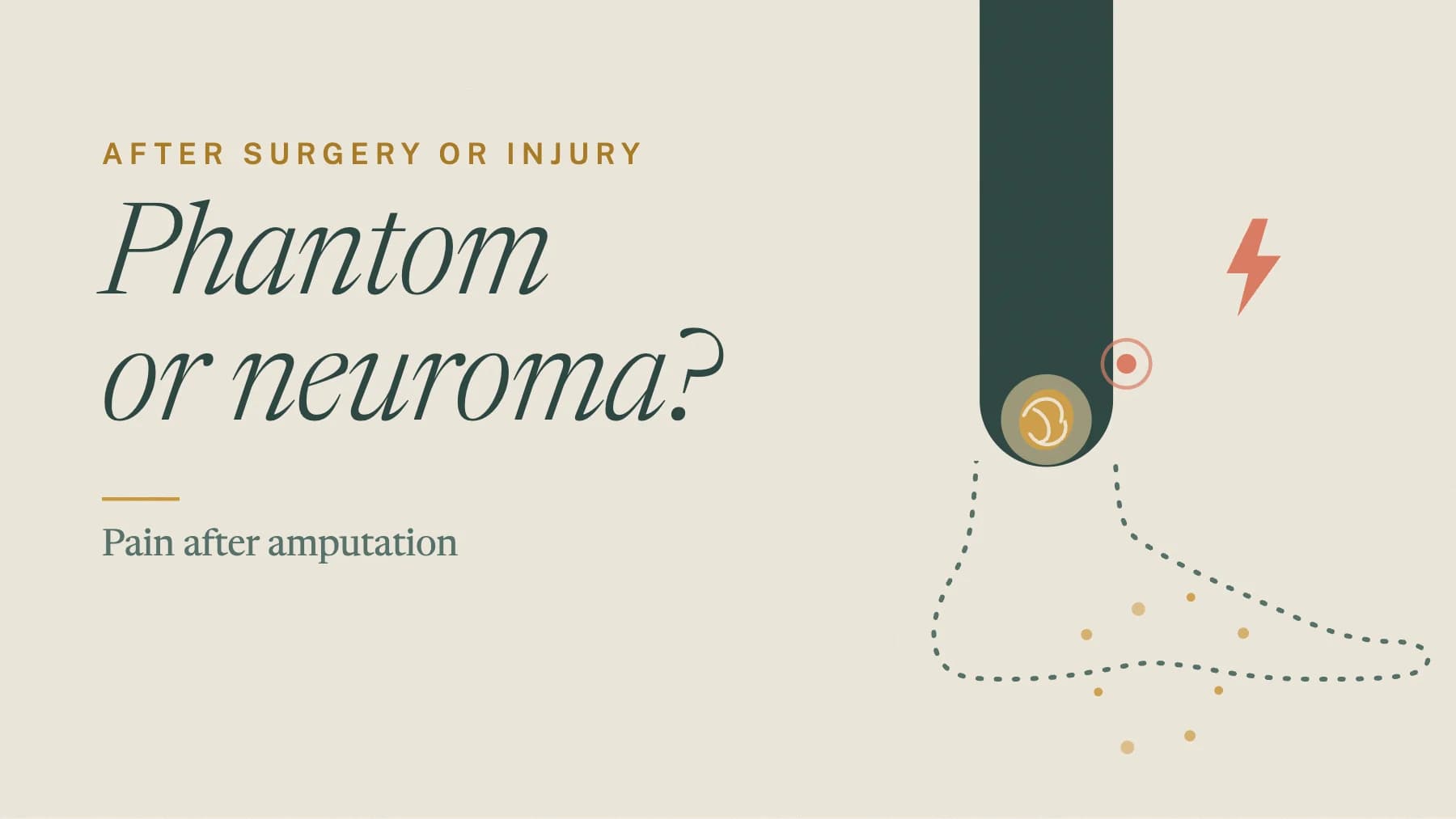
If you have had an amputation and you still hurt, the first question is where the pain comes from. Pain that seems to be in the foot that is no longer there is one thing. Pain at the end of the limb, especially a sharp, electric spot that flares when it’s touched or when the prosthesis presses, is another. They need different thinking, and they can exist side by side.
The two kinds of pain
Phantom limb pain feels as though it comes from the missing limb. It is different from phantom sensation, where you can feel the missing part without pain, and from residual limb pain, which is felt in the part that remains.[1] Phantom limb pain involves changes in how the brain and spinal cord process signals, along with activity in the injured nerve endings and psychological factors. Because several mechanisms are at work, treatment often needs more than one approach.[1,7]
A residual limb neuroma is a knot of nerve fibers at the end of a nerve that was cut. Each cut nerve tries to regrow, and without a target, the fibers tangle. A neuroma can be very painful, may prevent prosthesis use, and can reduce quality of life.[2]
How common each one is
- A pooled analysis of studies from 1980 to 2019 estimated that 64% of people with an amputation reported phantom limb pain, with wide variation between studies. Risk was higher with long-lasting pain before the operation, with higher-level amputations, and with pain in the residual limb.[3]
- A meta-analysis found residual limb pain in 59% and symptomatic neuroma in 15% of people after lower-extremity amputation.[2] Another meta-analysis of 1,329 lower-limb amputees reported symptomatic neuromas in 19% overall, and 30% in studies with at least three years of follow-up, compared with 3% in studies with shorter follow-up. That suggests some neuromas take years to become symptomatic.[4]
Clues that separate them
These are guides, not rules, and your clinician will sort them out with an examination:
- A tender spot at the end of the limb that reproduces a sharp, shocking or burning pain when tapped or pressed suggests a neuroma.
- Pain when the prosthesis presses on one area also points to a neuroma, and the socket can add to the pressure.
- Pain that seems to be in the foot or toes that are no longer there, with no tender spot, fits phantom limb pain.
- Both can be present. A neuroma can add to phantom pain.
An evaluation includes an examination of the residual limb, with attention to tender spots that shoot or tingle, the prosthesis fit and the skin, along with your medicines, sleep, mood and daily activity. Ultrasound or MRI can help show a neuroma, and a small anesthetic injection near the suspected nerve can help confirm the source. These tests are arranged with another specialist. Your prosthetist is an important partner.
What treatment can look like
- For phantom limb pain: medicines, brain and nerve stimulation, mirror therapy and rehabilitation have all been studied, and the strength of evidence differs among them. A network meta-analysis of 12 randomized trials found morphine linked to a higher rate of side effects, and repetitive transcranial magnetic stimulation gave the largest improvement, with moderate-quality evidence from a small number of trials. A review of placebo-controlled trials found the evidence for mirror therapy too weak to conclude that it works.[8]
- For a neuroma: prosthetic adjustments, desensitization, medicines and injections come first. When they don’t help enough, surgery targets the nerve directly.
- Surgery that gives the nerve somewhere to go. In a randomized trial of 28 people with chronic pain after amputation, targeted muscle reinnervation improved phantom limb pain compared with removing the neuroma and burying the nerve in muscle, and residual limb pain trended toward improvement.[5] A pooled analysis of 17 studies of targeted muscle reinnervation and regenerative peripheral nerve interface surgery found phantom limb pain improved in 45% to 80% of patients, although most studies were small. Complication rates ranged from 13% to 31%, most often slow wound healing.[6] See targeted muscle reinnervation and regenerative peripheral nerve interface.
Timing may matter. In a comparison of 105 limbs, a symptomatic neuroma recurred in 19% of limbs that had delayed targeted muscle reinnervation, compared with 1% of limbs that had it at the time of amputation.[9] If you are facing an amputation, it is worth asking your surgical team how the cut nerves will be managed.
What to do
Tell your care team about the pain early. It is real, and there are options. For more, see phantom limb pain, residual limb neuroma pain and pain after leg amputation.
When to see a specialist
Consider an evaluation if you have pain in an amputated limb that is not controlled, is affecting sleep or walking, or is accompanied by a tender, shocking spot in the residual limb.
About the author
Efe Ozturk, DPM
Foot and Ankle Surgeon. Dr. Ozturk is double board certified, as a Diplomate of the American Board of Podiatric Medicine (DABPM) and a Fellow of the Academy of Physicians in Wound Healing (FAPWH), and is a Fellow of the American Society of Podiatric Surgeons (FASPS) and the American Society of Podiatric Medicine (FASPM). He leads the Lower Extremity Nerve Institute, a specialty practice of Ozturk Foot & Ankle, and sees patients in Lyndhurst, Paramus and Millburn, New Jersey.
References
- 1.Flor H. Phantom-limb pain: characteristics, causes, and treatment. Lancet Neurol. 2002;1(3):182-9. PubMed 12849487 (external site)
- 2.List EB, Krijgh DD, Martin E, Coert JH. Prevalence of residual limb pain and symptomatic neuromas after lower extremity amputation: a systematic review and meta-analysis. Pain. 2021;162(7):1906-1913. PubMed 33470746 (external site)
- 3.Limakatso K, Bedwell GJ, Madden VJ, Parker R. The prevalence and risk factors for phantom limb pain in people with amputations: A systematic review and meta-analysis. PLoS One. 2020;15(10):e0240431. PubMed 33052924 (external site)
- 4.Huang YJ, Assi PE, Drolet BC, Al Kassis S, Bastas G, Chaker S, et al. A Systematic Review and Meta-analysis on the Incidence of Patients With Lower-Limb Amputations Who Developed Symptomatic Neuromata in the Residual Limb. Ann Plast Surg. 2022;88(5):574-580. PubMed 34270470 (external site)
- 5.Dumanian GA, Potter BK, Mioton LM, Ko JH, Cheesborough JE, Souza JM, et al. Targeted Muscle Reinnervation Treats Neuroma and Phantom Pain in Major Limb Amputees: A Randomized Clinical Trial. Ann Surg. 2019;270(2):238-246. PubMed 30371518 (external site)
- 6.Mauch JT, Kao DS, Friedly JL, Liu Y. Targeted muscle reinnervation and regenerative peripheral nerve interfaces for pain prophylaxis and treatment: A systematic review. PM R. 2023;15(11):1457-1465. PubMed 36965013 (external site)
- 7.Spezia MC, Dy CJ, Brogan DM. Phantom Limb Pain Management. J Hand Surg Am. 2025;50(2):208-215. PubMed 39436344 (external site)
- 8.Guémann M, Olié E, Raquin L, Courtet P, Risch N. Effect of mirror therapy in the treatment of phantom limb pain in amputees: A systematic review of randomized placebo-controlled trials does not find any evidence of efficacy. Eur J Pain. 2023;27(1):3-13. PubMed 36094758 (external site)
- 9.Goodyear EG, O'Brien AL, West JM, Huayllani MT, Huffman AC, Souza JM, et al. Targeted Muscle Reinnervation at the Time of Amputation Decreases Recurrent Symptomatic Neuroma Formation. Plast Reconstr Surg. 2024;153(1):154-163. PubMed 37199690 (external site)
This article is general health information and isn’t a substitute for advice from a clinician who knows your history. Read our medical disclaimer and how we review content.
More from the blog
After surgery or injury
Nerve pain at the front of the knee after knee replacement
When the implant looks fine but the front of the knee burns, a small nerve may be the cause. The clues and the options.
After surgery or injury
Nerve pain after Achilles surgery: the sural nerve
How often the sural nerve is affected after Achilles repair, what it feels like, and what can be done.
After surgery or injury
Complex regional pain syndrome after foot surgery: early signs
Pain that grows instead of fading, with skin or temperature changes, can be CRPS. The early signs and what to do.