Foot drop after surgery: what it means and what to do next
Toes catching after an operation? Why foot drop happens, how common it is, what to do right away, and what recovery can look like.

By Dr. Efe Ozturk · 5 min read
Medically reviewed by Dr. Efe Ozturk · Last reviewed
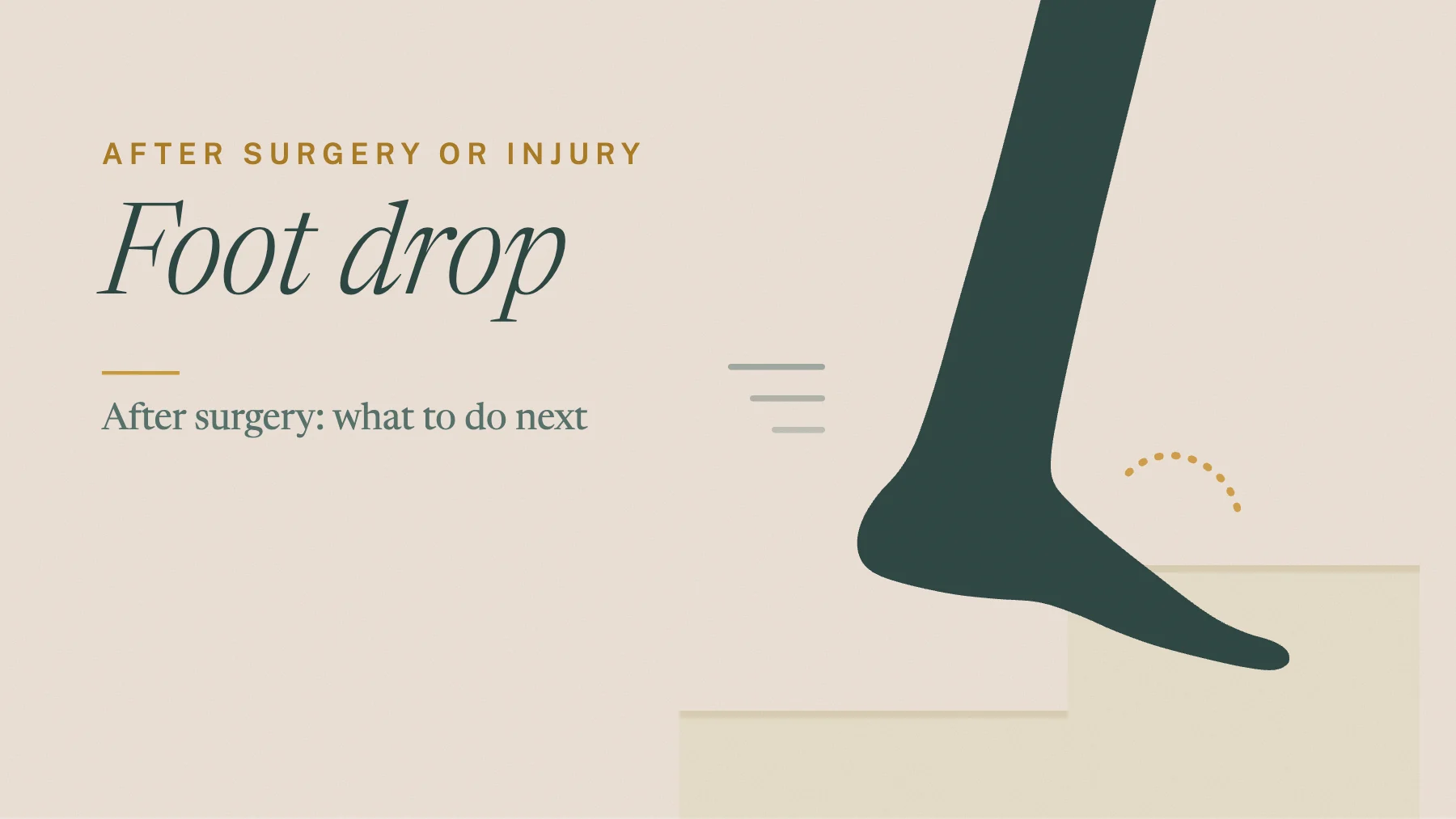
You wake up from an operation, or start walking afterward, and your toes catch on the floor. Your foot slaps down with each step, or you can’t lift it at all. It is frightening, and it is natural to wonder whether it will come back. Here is what is known, and what to do next.
What foot drop feels like
Foot drop is weakness in the muscles that raise the front of the foot and the toes. Your toes may drag, your foot may slap down after the heel hits the floor, or you may lift the knee higher than usual to clear the ground. Some people also have numbness on the top of the foot or the outer part of the lower leg.[1,5]
How common is it?
Foot drop after surgery is not common, but it is a recognized complication:
- Knee replacement. A systematic review of 47,585 knee replacements found 203 with a common peroneal nerve palsy, a cumulative incidence of 0.4%.[3] A single-center registry study found a similar rate of 0.32%. Epidural anesthesia, a knee that was significantly knock-kneed (valgus) before surgery, and female sex were associated with higher risk.[4]
- Hip replacement. Among 10,047 hip replacements, sciatic or peroneal nerve palsy occurred in 0.05% with the direct anterior approach and 0.46% with the posterior approach.[6]
These are averages from specific studies, and they can’t tell you your own risk. Your surgeon can.
Why it happens
The signal that lifts your foot travels a long way: from the brain, down the spinal cord, out of the lower spine as the L4 and L5 nerve roots, into the sciatic nerve, and on as the peroneal nerve. A problem at any point can cause foot drop, so finding where is the key step.[1,7]
After surgery, the usual suspects are:
- The peroneal nerve at the knee. It wraps around the outer side of the knee just under the skin, which is the most common site of compression. A tight cast, splint or brace can squeeze it.[5,7]
- The sciatic nerve. Higher-up injury or pressure can weaken the same muscles.[2]
- The L5 nerve root in the back. This is one of the two most common causes of foot drop overall, and it may be involved after or alongside spine problems.[1]
Sometimes more than one site is involved. See sciatica or a foot nerve problem? for how those can overlap.
What to do right away
- Tell your surgeon or surgical team the same day. Don’t wait for your next scheduled visit.
- Ask whether anything is pressing on the nerve. A tight cast, dressing, brace or wrap that is getting more numb or painful is an emergency, so call at once.
- Protect yourself from falls. A light ankle-foot orthosis (AFO), a brace that holds the foot up, is a helpful device that lets people with a severe foot drop walk better and more safely.[2]
- Ask for a proper evaluation. A careful examination can often show which nerve is affected. Nerve studies, arranged with another specialist, help locate the problem, measure how much nerve damage there is and estimate how well it may recover.[2,5]
What recovery looks like
Recovery depends on how severe the weakness is at the start. In the knee replacement review, 39% of people with a complete palsy had complete recovery, compared with 66% of those with an incomplete palsy, at an average follow-up of 3.6 years.[3] In the single-center study, about two-thirds of complete palsies and four-fifths of partial palsies recovered completely.[4] After hip replacement, full motor recovery occurred in about 58% of sciatic or peroneal palsies.[6]
Those figures are hopeful, but they also show that many people are left with some weakness. Nerves regrow slowly, about a millimeter a day, so recovery is measured in months, not weeks.[8]
If the nerve isn’t recovering
Options depend on the cause and on whether the nerve has a realistic chance to recover. Many people do well with a brace and therapy. Surgery is considered when a nerve can recover, when something is pressing on it, or when it has been cut.[5,1]
- Releasing the nerve at the knee. In a pooled analysis of 368 people who had the peroneal nerve released, ankle-lifting strength improved and serious complications were uncommon. About half (54%) reached full strength.[9] In a smaller series, those who had surgery within 12 months of symptom onset fared significantly better.[10]
- Nerve or tendon transfers. When a nerve is unlikely to recover, or a release didn’t work, working nerves or tendons can be used to restore the lifting movement.[5,11]
Timing matters, so don’t wait many months to ask for a second opinion if there is no improvement. Read more in foot drop, common peroneal nerve compression, nerve decompression and nerve transfer.
When to see a specialist
Have foot drop checked promptly, even if it seems mild. Get an evaluation soon if your toes catch when you walk, you have started to trip, or your foot feels weak or numb after a knee or hip operation, a fall or a long stretch in a cast.

About the author
Dr. Efe Ozturk
Foot and Ankle Surgeon. Dr. Ozturk is double board certified, as a Diplomate of the American Board of Podiatric Medicine (DABPM) and a Fellow of the Academy of Physicians in Wound Healing (FAPWH), and is a Fellow of the American Society of Podiatric Surgeons (FASPS) and the American Society of Podiatric Medicine (FASPM). He leads the Lower Extremity Nerve Institute, a specialty practice of Ozturk Foot & Ankle, and sees patients in Lyndhurst, Paramus and Millburn, New Jersey.
References
- 1.Carolus AE, Becker M, Cuny J, Smektala R, Schmieder K, Brenke C. The Interdisciplinary Management of Foot Drop. Dtsch Arztebl Int. 2019;116(20):347-354. PubMed 31288916 (external site)
- 2.Stewart JD. Foot drop: where, why and what to do?. Pract Neurol. 2008;8(3):158-69. PubMed 18502948 (external site)
- 3.Carender CN, Bedard NA, An Q, Brown TS. Common Peroneal Nerve Injury and Recovery after Total Knee Arthroplasty: A Systematic Review. Arthroplast Today. 2020;6(4):662-667. PubMed 32875016 (external site)
- 4.Høvik Ø, Jenssen KK, Amlie E, Sivertsen EA. Peroneal Nerve Palsy After Total Knee Arthroplasty. Arthroplast Today. 2024;26:101331. PubMed 38415067 (external site)
- 5.Poage C, Roth C, Scott B. Peroneal Nerve Palsy: Evaluation and Management. J Am Acad Orthop Surg. 2016;24(1):1-10. PubMed 26700629 (external site)
- 6.Slaven SE, Ho H, Sershon RA, Fricka KB, Hamilton WG. Motor Nerve Palsy After Direct Anterior Versus Posterior Total Hip Arthroplasty: Incidence, Risk Factors, and Recovery. J Arthroplasty. 2023;38(7S):S242-S246. PubMed 37019317 (external site)
- 7.Lezak B, Massel DH, Varacallo MA. Peroneal Nerve Injury. In: StatPearls. StatPearls Publishing; updated 2024. PubMed 31751049 (external site)
- 8.Bamba R, Riley DC, Kelm ND, Does MD, Dortch RD, Thayer WP. A novel technique using hydrophilic polymers to promote axonal fusion. Neural Regen Res. 2016;11(4):525-528. PubMed 27212898 (external site)
- 9.Chow AL, Levidy MF, Luthringer M, Vasoya D, Ignatiuk A. Clinical Outcomes After Neurolysis for the Treatment of Peroneal Nerve Palsy: A Systematic Review and Meta-Analysis. Ann Plast Surg. 2021;87(3):316-323. PubMed 34397520 (external site)
- 10.Ramanan M, Chandran KN. Common peroneal nerve decompression. ANZ J Surg. 2011;81(10):707-12. PubMed 22295311 (external site)
- 11.Khan AA, Rodriguez-Collazo ER, Lo E, Raja A, Yu S, Khan HA. Evaluation and Treatment of Foot Drop Using Nerve Transfer Techniques. Clin Podiatr Med Surg. 2021;38(1):83-98. PubMed 33220746 (external site)
This article is general health information and isn’t a substitute for advice from a clinician who knows your history. Read our medical disclaimer and how we review content.
More from the blog
After surgery or injury
Nerve pain at the front of the knee after knee replacement
When the implant looks fine but the front of the knee burns, a small nerve may be the cause. The clues and the options.
After surgery or injury
Nerve pain after Achilles surgery: the sural nerve
How often the sural nerve is affected after Achilles repair, what it feels like, and what can be done.
After surgery or injury
Phantom pain or a neuroma after amputation: telling them apart
Phantom limb pain and a residual limb neuroma can look alike and can coexist. How they differ and what treatment offers.